



























Commissions are a substantial aspect of sales. As a business owner, you must look for the right balance, whether it’s on the lower or higher side. In both cases, they can significantly impact your business.
However, the ideal sales commission for other businesses may not suit your new or established business. That’s because the industry, product/service, business goals, standing, and several other factors highly impact commission rates.
There isn’t a straightforward approach to this. You will need to evaluate the average commission rates applied in various industries.
This blog post will explain average sales commission rates by industry in detail.
What Do You Mean by Sales Commission Rates?
Sales commission rates are the percentage a small or large business pays its sales reps when they make a sale. Several factors influence this rate, including the length and complexity of the sales cycle, the nature of the sales role, market competition, and current industry norms, to name a few.
Although typical sales commission rates are set in each industry, most companies adopt an individual approach to their sales commission rates.
Why Typical Commission Rates Matter in 2025
Typical commission rates refer to the standard commission percentage offered to sales reps within a specific industry. It shows the standard compensation model used by companies in that sector.
And Why Does It Matter?
Having this benchmark allows businesses, whether small or large, to comprehend the level of incentives needed to keep a sales team motivated, smart enough to face market competition, and drive growth.
In short, it enables businesses to align their compensation tactics with industry trends, attracting top talent and retaining their best performers.
Thus, a standard sales commission rate serves as a benchmark to optimize your compensation structures. To meet the market’s ever-changing demands, businesses must monitor their commission strategies and practices.
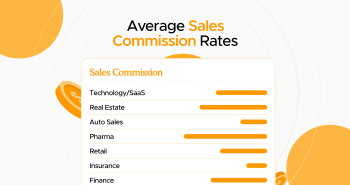
Average Sales Commission Rates by Industry
| Industry | Commission Rate | Notes |
|---|---|---|
| Technology/SaaS | 5-20% | Often base + quota-based accelerators |
| Real Estate | 4–6% (residential), 4–8% (commercial) | Varies by location, commission-only, |
| Auto Sales | 20-30% | Mostly commission-only |
| Pharma | % varies; avg ~$45k/year commission | High base + travel demands |
| Travel | 1-20% | Tiered by volume or flat fees |
| Retail | 15% (high-ticket items) | Typically, with quotas |
| Insurance | 5-15% | Captive vs. independent agents |
| Finance | 0.25-10% | Based on product (funds vs. annuities) |
How Can We Determine the Correct Sales Commission Rate?
Setting the correct commission rate is mandatory for all businesses. The commission rate heavily relies on one criterion, which warrants a sales team’s motivation, profitability, and performance overall.
So here is a roadmap on how to govern the correct commission rate for any business:

Understand Industry Benchmarks
Each niche or industry follows its own set of sales commission rates. Knowing that an industry benchmark will give you a good start.
Evaluate Profit Margins
You must be aware of the profit you make. As a result, you can assign a lucrative commission rate to encourage your sales team, but it should not increase your costs in any way.
Consider Sales Cycle & Role Complexity
Understand and appreciate the hard work that your sales team puts in. A sales rep who has to go through a more complex and longer sales cycle must receive better incentives and increased rates.
Assess Sales Goals & Targets
Clearly describe your sales expectations. This thoughtfulness will help determine the commission rate that will elicit the expected behavior and motivation in your sales reps.
Gather Feedback from Sales Team
Ask your sales reps about their realistic demand. Proactively discover what truly pushes them forward. It would be best for you to get their feedback about the impact of the incentive plans. These conversations allow businesses to collect insights on what works best in practice.
Execute Financial Modeling
Before finalizing a commission rate, calculate the potential cost to your company for low, average, or high performance. This forecasting helps estimate if the rate is profitable, regardless of the sales performance.
Test and Iterate
You must test your potential commission rate before implementing it practically. Analyze the performance, assess its effectiveness, and measure the outcomes. Insights obtained from the beta test will allow you to make proper adjustments and improvements to achieve the desired results.
From research to testing, your chosen commission rate must follow a detailed yet step-by-step process. This will enable you to attain the best return on the money you invest in your sales team and their incentives.
What Do You Mean by Sales Commission Structure?

The total amount that a rep is paid depends on target earnings. These earnings comprise a fixed amount and variable pay or salary. Sales commission structures determine how much a rep’s variable pay will be.
Commission structures explain how representatives receive their variable incentive pay. Moreover, they provide clarity to them on how many sales they must make to help them achieve their financial goal. As a result, sales representatives will realize how accurate and fair their commissions are.
Use a Trusted Plugin
You can depend on a reliable plugin, Sales Agent for WooCommerce, when setting up an appropriate sales commission structure for agents. It helps you accurately reward your sales agents based on their performance.
Moreover, you can set commissions at the product, category, or global level. Likewise, you can update commission rates to achieve business goals or objectives accordingly.
What is a Reasonable Commission Rate for Sales?
A reasonable commission rate usually falls between 5% and 20% of the sale value, depending on deal size and industry. The sales commission prices of high-ticket sectors, such as SaaS, auto, and real estate, are typically on the higher side.
Is 20% Commission Normal?
Yes, 20% commission is standard in industries with high-ticket sales or high margins, such as enterprise software, auto sales, or luxury goods. In lower-margin sectors like retail, commission rates vary from 5% to 10%.
What is the Minimum Commission for B2B Sales?
B2B sales commissions usually have a range from 5–15% of deal value, with SaaS and enterprise contracts mainly comprising accelerators that help elevate payouts above 15% once quotas are surpassed.
What are the Three Main Types of Commissions?
The three most crucial commission structures are:
- Straight commission – 100% of pay is based on sales.
- Base salary + commission – Variable pay, along with a mix of fixed salary.
- Tiered commission – higher rates as sales targets are exceeded.
What Does the Phrase “Sales Commission Prices” Mean?
The phrase “sales commission prices” refers to another term, “sales commission rates”. As per this phrase, a salesperson can earn a fixed amount or a percentage of the sale value as commission upon making a sale. Therefore, you should not get confused if someone says sales commission prices instead of sales commission rates.
Wrapping Up
In reality, a “perfect” commission rate or structure does not exist. What works for or suits a software company with recurring profits might differ entirely from what works for a retail business with tighter margins. The key is to align a commission plan with the company’s or business’s overall tactics and sales objectives.
A well-organized commission plan not only keeps your sales team motivated and energetic—it helps develop a sense of clarity, fairness, and much-needed clarity. Additionally, sales representatives have expertise in fulfilling and exceeding the expectations of their employers, as well as understanding what they will likely achieve in return for their hard work or outstanding performance.
Meanwhile, the business takes advantage of enhanced performance, increased retention rates, and results-driven financial outcomes. We expect you would appreciate our blog post, which describes average sales commission rates.