














































C#, spoken as C Sharp, has made giant progress in the domain of modern web development. Through various previous and recent releases, C# has emerged as a massive language in today’s era.
The great thing that makes C# an invaluable language is its continuous evolution, allowing users to perceive it in the shape of numerous versions, launching exciting features, fixes, and enhancements at all times.
This blog post will explain the C# version history, previous versions, latest releases, improvements, and more.
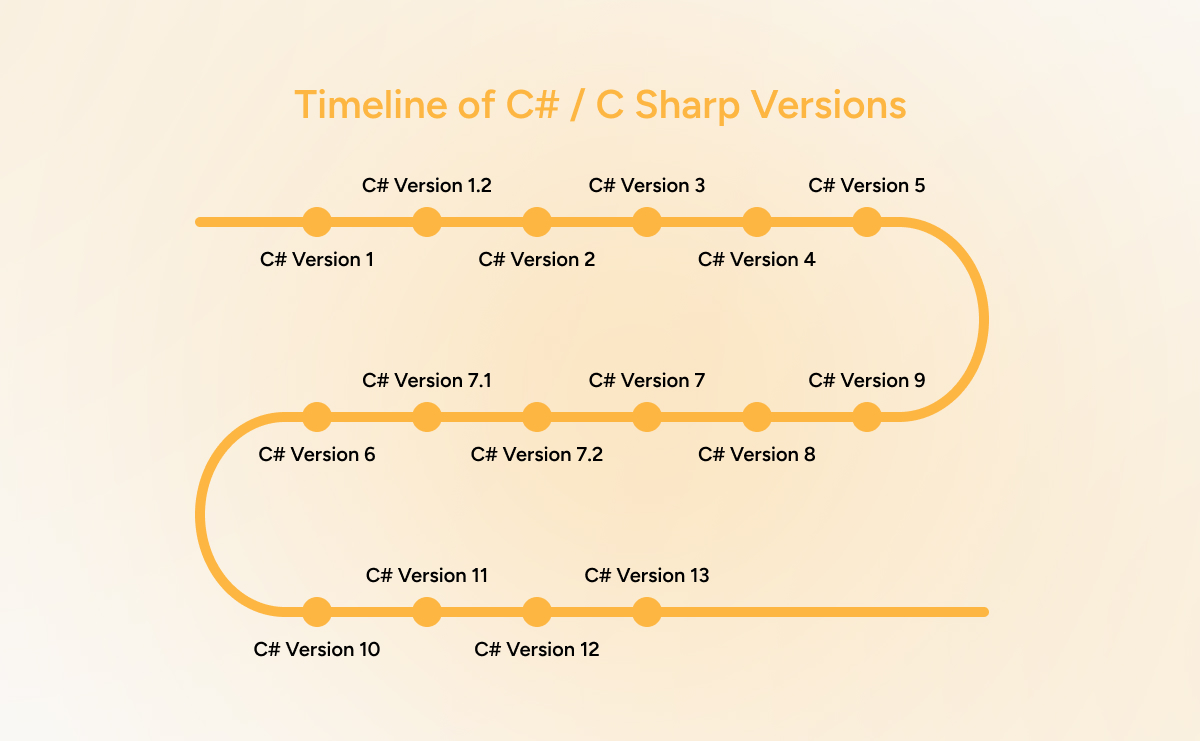
C# Version History / C Sharp Version History (C# Version History List)
This section will specifically focus on thoroughly covering previous versions and releases of C #.
C# Version 13
The current or latest version of C# is 13, which was officially introduced in November 2024. The famous C# 13 comprises the following new features:
- New escape sequence – \e: You can use \e as a character literal escape sequence for the ESCAPE character, Unicode U+001B.
- Small optimizations to overload resolution comprising method groups.
- Implicit indexer access in object initializers: The implicit “from the end” index operator, ^, is now allowed in an object initializer expression.
- params collections: The params modifier isn’t limited to array types. You can now use params with any recognized collection type, including Span<T>, and interface types.
- New lock type and semantics: If the target of a lock statement is a System.Threading.Lock, the compiler generates code to use the Lock.EnterScope() method to enter an exclusive scope. The ref struct returned from that supports the Dispose() pattern to exit the exclusive scope.
- You can use ref locals and unsafe contexts in iterators and async methods.
- You can use ref struct types to implement or apply interfaces.
- You can allow ref struct types as arguments for type parameters in generics.
- Indexers and partial properties are available in partial types.
- Overload resolution priority enables library authors to assign one overload as better than others.
Furthermore, the field contextual keyword was released to access the compiler-generated backing field in an automatically applied property as a preview feature.
C# Version 12
C# is one of the latest releases, made publicly available in November 2023. The notable C# contains the following exciting features:
- Primary Constructors – You can create primary constructors in any class or struct type.
- Collection Expressions – A new syntax to mention collection expressions, including the spread element (..e), to expand any collection.
- Inline Arrays – Inline arrays allow you to create a variety of fixed-size arrays in a struct type.
- Optional Parameters in Lambda Expressions – You can explain default values for parameters in lambda expressions.
- ref readonly Parameters – ref readonly parameters allow more clarity for APIs that may use ref parameters or in parameters.
- Alias any Yype – You can use the alias directive to alias any type, not just named types.
- Experimental Attribute – Denotes an experimental feature.
Note: Another impressive feature, Interceptors, was launched as a preview feature.
Undoubtedly, C# 12 introduces a range of impressive features to users, enhancing their productivity when writing C# code.
C# Version 11
C# version 11 was officially launched in November 2022. This was one of the most impactful C# releases that delighted users with the following features:
- Generic math support
- Generic attributes
- UTF-8 string literals
- Auto-default structs
- Pattern match Span<char> on a constant string
- Extended nameof scope
- Raw string literals
- Numeric IntPtr
- Newlines in string interpolation expressions
- List patterns
- File-local types
- Required members
- ref fields and scoped ref
- Improved method for group conversion to delegate
- Warning wave 7
C# version 11 was one of the latest versions that introduced a great mix of generic math and other helpful features. It allowed users to write numeric algorithms once for all number types. This is the reason we have included it in the list of C# releases.
C# Version 10
C# Version 10 was officially launched in November 2021. It offered the following features and improvements to users:
- Record structs
- Improvements of structure types
- Interpolated string handlers
- Global using directives
- File-scoped namespace declaration
- Extended property patterns
- Lambda expressions contain a natural type, where the compiler can infer a delegate type from the lambda expression or method group.
- Lambda expressions can declare a return type when the compiler can’t infer it.
- Attributes can be implemented in lambda expressions.
C# 10 continued working on themes of clearing ceremony, separating data from algorithms, and enhanced performance for the .NET Runtime.
C# Version 9
C# Version 9 was officially launched in November 2020. The previous C# releases contain the following features:
- Records
- Init only setters
- Top-level statements
- Performance and interop
- Native sized integers
- Function pointers
- Suppress emitting localsinit flag
- Module initializers
C# 9 continued enhancing three themes from previous releases: removing ceremony, separating data from algorithms, and delivering more patterns in more places.
C# Version 8
C# Version 8 was officially announced in September 2019. This is one of the leading yet old versions of C# that delighted users with a wide range of compelling features, including:
- Using declarations
- Static local functions
- Disposable ref structs
- Nullable reference types
- Asynchronous streams
- Indices and ranges
- Null-coalescing assignment
- Unmanaged constructed types
- Stackalloc in nested expressions
C# 8 was arguably the first significant release of C # that primarily focused on .NET Core. A few features were dependent on the new Common Language Runtime (CLR) capabilities. Similarly, other features relied on library types that were included in .NET Core.
C# Version 7
C# version 7 was officially released in March 2017. The version introduced the following features:
- Out variables
- Tuples and deconstruction
- Pattern matching
- Local functions
- Expanded expression-bodied members
C# Version 7.2
C# version 7.2 was an update to the previous release of C# 7.1. It included the following features:
- Access fixed fields without pinning
- Initializers on stackalloc arrays
- Reassign ref local variables
- Fixed statements that support a pattern
C# Version 7.1
C# version 7.1 was officially released in August 2017. It contained the following features:
- Inferred tuple element names
- async Main Method
- Pattern matching on generic type parameters
C# Version 6
C# version 6 was officially launched in July 2015. It comprises various minor features, improving the impact and productivity of the C# programming language:
- Static imports
- Exception filters
- Auto-property initializers
- Expression-bodied members
C# Version 5
C# version 5 was officially released in August 2012. The famous version of C Sharp language was announced along with Visual Studio 2012. C# version 5 contained the following features:
- Asynchronous members
- Caller info attributes
C# 5 is one of the older versions of the C# language that significantly enhanced the language, making it more helpful for contemporary web development.
C# Version 4
C# version 4 was officially released in April 2010. This C # release offered the following features to users:
- Dynamic binding
- Named/optional arguments
- Generic covariant and contravariant
- Embedded interop types
C# Version 3
C# version 3 was officially made available in November 2007. This old version of C# revolutionized the C # language by introducing the following features:
- Auto-implemented properties
- Anonymous types
- Query expressions
- Lambda expressions
- Expression trees
- Extension methods
C# Version 2
C# version 2 was released in November 2005. The C# previous version contained the following features:
- Partial types
- Anonymous methods
- Nullable value types
- Iterators
- Generics
As you might be aware, C# or C Sharp started its journey as an OO (Object-Oriented) language. However, the launch of C# 2 completely revamped the famous programming language.
C# Version 1.2
C# version 1.2 was released in April 2003. The update comprised some enhancements to the language. The crucial change in this version was the code generated by a foreach loop named Disponse, which was applied to an IEnumerator that implemented IDisposable.
C# Version 1
Microsoft released C# Version 1 in January 20022. This pioneer C# release changed the web development sphere for all the right reasons. It included the following features:
- Interfaces
- Events
- Properties
- Delegates
- Operators and expressions
- Statements
- Attributes
Users didn’t find built-in async capabilities in the C# Version 1. In addition, some of the slick functionality around generics was also nonexistent. C# version 1 looked pretty stripped of features, to say the least, but that was understandable at that time.
What is the Difference between C# and C Sharp?
Surprisingly, both these terminologies are the same since “C#” and “C Sharp” have the identical meaning. As you may be aware, “C Sharp” is the pronunciation of the “C#”, which is the written form of the popular programming language.
It uses the Number sign (#) and the Latin Capital Letter C, which is the desired and appropriate style of representing the language in code and text. When users usually speak, they pronounce the language as “C Sharp”.
What does the Phrase C# Releases mean?
The phrase “C# releases” refers to the numerous versions and updates of the popular programming language C#. These releases include previous versions of C #, such as C# Version 4, among others. Besides, C# releases also comprise old versions of C#.
If you want to explore C #’s previous versions and latest ones, go through C# releases thoroughly.
Wrapping Up
C# version history is both informative and impactful. As you know, different releases of C# over time have made this programming language beneficial and results-driven for users and businesses alike.
Therefore, developers, whether they are new or experienced, must understand the importance of C# releases, including both old and recent versions, updates, and improvements. This way, they can benefit from the resourceful programming language by making advanced yet results-driven solutions.