






































At its core, GitHub helps teams create and organize code repositories, monitor or keep an eye on changes, and collaborate on development under one roof, following the key principles described in GitHub version history. It’s handy for remote teams working on open-source or internal projects.
Besides this, GitHub offers remarkable features like time tracking, which helps teams measure progress, monitor productivity or efficiency, and enhance overall project effectiveness. As you might know, more than 60 million new repositories have been created, and GitHub has played a decisive role in software development.
This blog post will describe the GitHub version history and the inspiring future in one place.
GitHub Version History (GitHub Version List)
The famous code development and management platform has facilitated coders and website developers globally, regardless of their professions and associations. The table described below includes GitHub’s current version, GitHub’s previous version, and additional versions of GitHub.
|
Version |
Release |
Deprecated Date |
| GitHub 3.16 | 2025-02-25 | 2026-03-11 |
| GitHub 3.15 | 2024-11-12 | 2025-12-19 |
| GitHub 3.14 | 2024-08-06 | 2025-08-27 |
| GitHub 3.13 | 2024-05-16 | 2025-06-04 |
| GitHub 3.12 | 2024-02-13 | 2025-04-03 |
| GitHub 3.11 | 2023-11-14 | 2024-12-19 |
| GitHub 3.10 | 2023-08-08 | 2024-09-25 |
| GitHub 3.9 | 2023-06-08 | 2024-07-26 |
| GitHub 3.8 | 2023-02-07 | 2024-03-26 |
| GitHub 3.7 | 2022-10-25 | 2024-01-04 |
| GitHub 3.6 | 2022-07-26 | 2023-09-25 |
| GitHub 3.5 | 2022-05-10 | 2023-06-29 |
| GitHub 3.4 | 2022-02-15 | 2023-03-23 |
| GitHub 3.3 | 2021-11-09 | 2023-01-18 |
| GitHub 3.2 | 2021-09-09 | 2022-10-12 |
| GitHub 3.1 | 2021-05-06 | 2022-06-30 |
| GitHub 3.0 | 2021-01-12 | 2022-02-16 |
| GitHub 2.22 | 2020-08-26 | 2021-09-23 |
| GitHub 2.21 | 2020-05-12 | 2021-06-09 |
| GitHub 2.20 | 2020-01-14 | 2021-03-02 |
| GitHub 2.19 | 2019-10-15 | 2020-11-12 |
| GitHub 2.18 | 2019-07-23 | 2020-08-20 |
| GitHub 2.17 | 2019-04-25 | 2020-05-23 |
| GitHub 2.16 | 2018-12-25 | 2020-01-22 |
| GitHub 2.15 | 2018-09-18 | 2019-10-16 |
| GitHub 2.14 | 2018-06-14 | 2019-07-12 |
| GitHub 2.13 | 2018-02-27 | 2019-03-27 |
| GitHub 2.12 | 2017-11-14 | 2018-12-12 |
| GitHub 2.11 | 2017-08-16 | 2018-09-13 |
| GitHub 2.10 | 2017-05-08 | 2018-06-05 |
| GitHub 2.9 | 2017-02-01 | 2018-03-01 |
| GitHub 2.8 | 2016-10-12 | 2017-11-09 |
| GitHub 2.7 | 2016-07-06 | 2017-08-03 |
| GitHub 2.6 | 2016-03-29 | 2017-04-26 |
| GitHub 2.5 | 2016-01-12 | 2017-03-14 |
| GitHub 2.4 | 2015-09-15 | 2017-02-09 |
| GitHub 2.3 | 2015-07-06 | 2016-11-01 |
| GitHub 2.2 | 2015-04-01 | 2016-08-03 |
| GitHub 2.1 | 2014-12-23 | 2016-04-26 |
| GitHub 2.0 | 2014-10-14 | 2016-02-09 |
Note: The above table consists of GitHub previous version. It also includes the old versions of GitHub.
What is GitHub Used for?

GitHub enables you to develop, save, change, collaborate, and merge code or files. Depending on their specific needs, any team member can utilize the GitHub repository (you can assume the GitHub repository is a folder for files) and see the most recent version in real time. As a result, they can alter or edit what the other collaborators see.
GitHub also allows users to make requests of one another and internally debate the iterations along the way. It’s a social coding platform because it calls people to coordinate, share, and collaborate on code across distributed and asynchronous environments.
How Can We Use GitHub as a Portfolio?
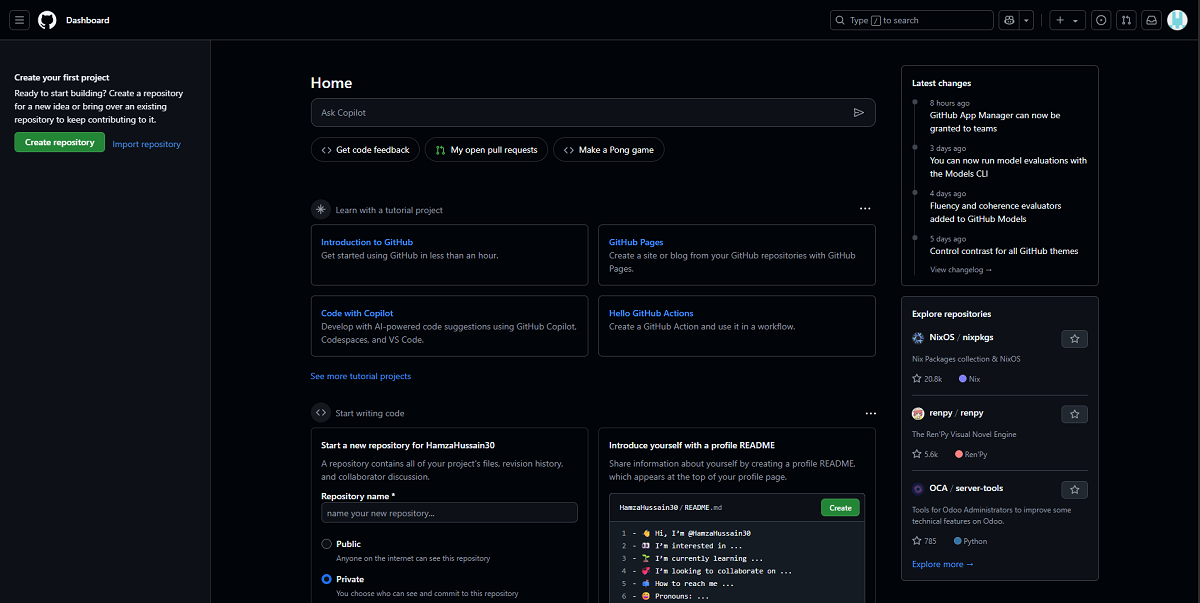
Using GitHub for your e-portfolio proves technological savvy, empowering you to differentiate yourself from others in this digital world. You can benefit from the steps below when using GitHub to create your portfolio:
- You must create an account by signing up for a free GitHub account.
- Create your content in a separate platform (e.g., Word or Google Docs), ensuring you possess a master copy.
- Create a new repository to incorporate your work into a GitHub project board. GitHub repositories are publicly visible by default, so you and other users can access them anytime. However, you must set them to private if you are working on them or they’re a work in progress.
- You can easily share your work with others and ask for their feedback.
- You can edit and revise in the collaborative interface.
- You can publish your work on a GitHub page that is open to the public.
- You can also share your final portfolio with your network of prospective employers. You can also mention your work on your resume and LinkedIn profile.
What is the Main Advantage of GitHub?
GitHub allows you to access almost 30 million public code repositories using a free account. In addition, non-programmers can benefit from unlimited collaborators, and version control is supported. It is easy to start, and once your files are in GitHub, sharing the repository with others is simple and does not require rocket science.
Who Can Use GitHub?
As you know, developers usually rely on GitHub when working together on a single project with the benefit of version control. This can prevent them from duplicating work. Furthermore, GitHub helps developers try new things, including code.
If the changes are not desirable or encouraging, they can return to the older version without fuss. Moreover, they can access the older versions of GitHub without issues.
You’ll also find others using GitHub, such as:
- Scientific Researchers
- Website Content Creators
- Computer Programmers
- Software Engineers
- Students
What is the Future of GitHub?
Before discussing the future of a leading code development and management platform, including the GitHub history and GitHub version list, it is crucial to note that the GitHub latest version is 3.17.0. This means that the latest GitHub release is also 3.17.0.
Regarding GitHub’s future, Chief Product Officer Mario Rodriguez paints a picture of an audacious and impactful future in GitHub’s San Francisco headquarters. “A world where a billion people create software, many without writing a single line of code. This vision challenges our understanding of being a developer, and not everyone is convinced it’s the right path forward.”
If we specifically talk about the latest tool of GitHub, Spark. It practically showcases this philosophy. Besides, it promises to allow users to develop and improvise applications through natural language commands rather than conventional programming. If you’re experiencing déjà vu, you’re not alone – the industry has been here before.
Dreams of Democratization: A History of Hope and Hurdles
According to Sarah Chen, a veteran software architect who remembers the excitement around Visual Basic in the 1990s. “The dream of democratizing software development is as old as software itself.” In addition, “every decade brings a new promise of coding without code.” From CASE tools to drag-and-drop interfaces, from WordPress to Wix, the industry has repeatedly attempted to make software development accessible to everyone.”
There is no denying that each wave of democratization has experienced similar challenges. “Natural language is ambiguous by nature,” suggests Dr. James Morrison, a computer science professor at MIT. “Programming languages are precise because they need to be. The gap between what you mean and what you say becomes a critical issue when instructing a computer.”
The AI Game-Changer
However, GitHub argues that something is different this time: artificial intelligence. The company believes we’re at a turning point with tools like Copilot helping 1.8 million paying customers write code. The platform hosting 90% of Fortune 500 companies’ code isn’t just theorizing—it’s betting on this future.
However, the transition hasn’t been entirely smooth. Some developers report developing a “Copilot pause” – waiting for AI suggestions even when the tool isn’t active. “It’s like developing a dependency,” admits Rodriguez, “but the first person who got into a car didn’t know how to drive right away either.”
The Citizen Developer Revolution
This vision correlates with a broader movement gaining momentum: citizen development. Businesses, companies, or organizations increasingly depend on non-technical professionals to create applications using low-code and no-code platforms. “It’s not about replacing developers,” explains Maria Gonzalez, Head of Digital Transformation at a Fortune 100 company. “It’s about enabling domain experts to solve their problems while letting developers focus on more complex challenges.”
Technical Realities and Limitations
Unfortunately, significant hurdles exist between technical realities and limitations. Security experts alert us regarding the implications of democratized development. “Every application is a potential security vulnerability,” says cybersecurity researcher Alex Thompson. How do we maintain security standards when anyone can create an app?”
Performance optimization, scalability, and maintenance also pose challenges. While natural language might be great for creating simple applications, complex systems require deep technical understanding. “There’s a reason why programming languages evolved as they did,” notes Chen. “Some concepts simply can’t be expressed effectively in natural language.”
The Professional Developer’s Evolution
If we say that democratization will help redefine their role, we are right to a certain degree. “Think of it like modern architecture,” suggests Rodriguez. “We still need architects to design skyscrapers, but now we also have tools that help homeowners remodel their kitchens.”
Professional developers will likely concentrate on developing frameworks, ensuring security, optimizing performance, and managing complicated technical challenges that natural language commands are unable to address. “The fundamentals of computer science aren’t going away,” Dr. Morrison emphasizes. “We are including new layers of abstraction.”
A More Nuanced Future
At this technological crossroads, GitHub’s vision encourages us to think about a more inclusive future for software development. That said, the most realistic vision is not complete democratization but of a spectrum, where natural language tools coexist with conventional programming, each fulfilling various needs and users.
The question isn’t whether everyone will become a developer but how to make technology more accessible while respecting its complexities. In this future, the definition of a developer might expand, but the need for expertise, understanding, and careful craftsmanship remains as crucial as ever.
As Rodriguez puts it, “We’re not trying to eliminate programming—we’re trying to eliminate the barriers that keep people from bringing their ideas to life.” Whether this vision succeeds where others have failed remains to be seen, but one thing is sure: the next chapter in programming’s evolution will be its most fascinating yet.
Wrapping Up
We hope you will appreciate our blog post, which thoroughly describes the history of GitHub versions. According to GitHub’s version history, the famous platform started its journey in 2008 and continues to grow massively worldwide. Users can benefit from the latest GitHub release in 2025 according to their specific demands.
In addition, they can experience much-improved security features and collaboration capabilities, which can transform the effectiveness of a leading code management platform to the next level.
Not to mention that the GitHub releases during the last two decades have allowed website developers and other stakeholders to improve their productivity upwardly. Hopefully, GitHub’s current version will grow over time and embrace new trends and approaches, such as enhanced security, AI, automation, and more.
Therefore, developers will likely prefer GitHub over other code management platforms in the future.