



























Java is a popular programming language that has played a crucial role in successful software development and powers mobile applications, web apps, and enterprise systems.
Exploring the Java version history not only deepens your knowledge and awareness of past releases but also helps you understand how Java has progressed over the past three decades. In today’s era, keeping up to date with the latest and previous versions of Java helps enhance the security and performance of multiple web and mobile applications.
This blog post will discuss the history of Java versions, including older versions and the latest releases.
Java Version History Timelines
Java has been in the market since the mid-1990s. The first version of Java was officially launched in 1996. Likewise, its latest version was released in March 2025. The platform has been helping developers simplify web development tasks for the past three decades.
The Java Version list below provides an overview of all Java SE versions, from their inception to the latest.
|
Java SE Version |
Version Number |
Release Date |
| JDK 1.0 (Oak) | 1.0 | January 1996 |
| JDK 1.1 | 1.1 | February 1997 |
| J2SE 1.2 (Playground) | 1.2 | December 1998 |
| J2SE 1.3 (Kestrel) | 1.3 | May 2000 |
| J2SE 1.4 (Merlin) | 1.4 | February 2002 |
| J2SE 5.0 (Tiger) | 1.5 | September 2004 |
| Java SE 8 | 1.8 | March 2014 |
| Java SE 9 | 9 | September 21, 2017 |
| Java SE 10 | 10 | March 20, 2018 |
| Java SE 11 | 11 | September 25th, 2018 |
| Java SE 12 | 12 | March 19, 2019 |
| Java SE 13 | 13 | September 17, 2019 |
| Java SE 14 | 14 | March 17, 2020 |
| Java SE 15 | 15 | September 15, 2020 |
| Java SE 16 | 16 | March 16, 2021 |
| Java SE 17 | 17 | September 14, 2021 |
| Java SE 18 | 18 | March 22, 2022 |
| Java SE 19 | 19 | September 20, 2022 |
| Java SE 20 | 20 | March 21, 2023 |
| Java SE 21 | 21 | September 19, 2023 |
| Java SE 22 | 22 | March 19, 2024 |
| Java SE 23 | 23 | September 17, 2024 |
| Java SE 24 | 24 | March 18, 2025 |
| Java SE 25 (LTS) | 25 | September 16, 2025 |
History of Java (Brief Explanation)
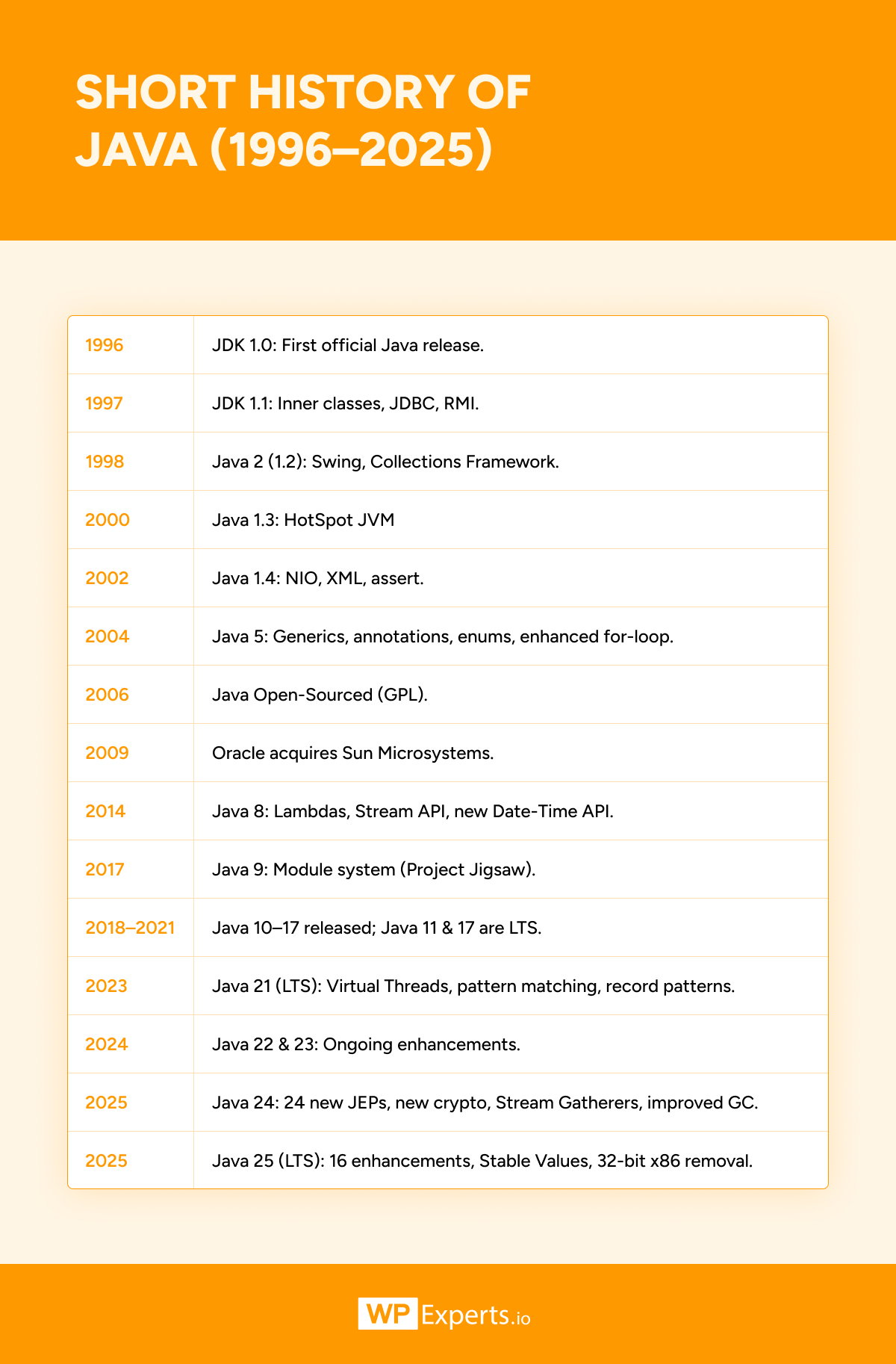
Java is a renowned server-side programming language that began in the 1990s. The mastermind behind Java is Sun Microsystems, which launched the platform to capture the attention of a broad audience.
The first public version is known as JDK (Java Development Kit) 1.0. Undoubtedly, Java has transformed itself into a breathtaking platform through different versions and improvements over time.
Consequently, users have experienced numerous exciting language features along with improved libraries. Moreover, they can go through the Java version list to understand how this amazing programming language has evolved.
What is JDK, and Why is It Used?
JDK, short for Java Development Kit, is a development environment for creating applets, components, and applications using the Java programming language. As for JDK, it comprises crucial tools for testing and developing programs written in the Java programming language and running on the Java platform.
What Do You Mean by Java SE?
As you may be aware, Java SE (Java Standard Edition, formerly called J2SE) is a set of libraries, programs, and tools that allows users to create and install Java applications on servers and desktops. In addition, developers benefit from Java SE when developing desktop apps that run on the JVM (Java Virtual Machine).
When Was Java 5 Released?
Java 5 was released on September 30, 2004, alongside a potent mix of new features. Starting with Java 5, the major version was dropped. Hence, the next version of Java 1.4 was called 5. Java 5 contains the following features:
- Generics
- Enhanced for Loop
- Static import
- Annotations
- Concurrency Utilities (java.util.concurrent)
- Monitoring and Management APIs
- Autoboxing/Unboxing
- Typesafe Enums
- Varargs
What is the Future of Java Releases?
In general, Java releases include new features, improvements, and updates. For instance, Java SE 25 delights existing and new users with various enhancements, such as improved platform performance and stability, expanded AI capabilities, and more.
This means that users will experience an array of exciting features and enhancements when utilizing future Java releases and updates. So, the future of Java, a popular and multipurpose object-oriented programming language, looks promising and rewarding.
That’s because billions of devices, including enterprise software and mobile applications, benefit from Java, which offers a key feature: platform independence, enabling code to run across various systems via a JVM (Java Virtual Machine).
Why Does Java Launch Various Versions?
Not only Java, but every programming language releases several versions when needed. Each version includes new features and enhancements to existing ones. Furthermore, it removes any errors or bugs and updates features in the previous versions.
What Happens If We Use Old Java Versions?
When you use old versions of Java, you will not be able to use the latest features and improvements. Therefore, you should not run software on old Java versions; otherwise, you may encounter compatibility issues, a lack of security patches, etc.
If you still use older versions of Java, consider updating them soon, as they may not meet your demanding development needs.
What Do You Mean by Java Syntax?
As for Java syntax, it is a set of rules and grammar that determine how Java programs are written and designed. As a result, the Java compiler can easily comprehend the code and execute it appropriately.
What is a Java Compiler?
A Java compiler primarily serves as a program that interprets Java source code into a transitional format, known as Java Bytecode. Typically, developers write the Java source code. In addition, the JVM (Java Virtual Machine) executes the bytecode.
Wrapping Up
The Java version history is impressive and a marvelous example of continuous improvement and evolution. However, you must closely examine the Java version list and understand how its versions relate to one another. This way, you can identify the right time to upgrade to the latest Java version and make informed decisions based on your project requirements.
Whether you are a beginner or an experienced programmer, exploring the basics of Java’s version history gives you a clear advantage. That’s because you can scale your existing web development projects upward and make the most of the notable programming language.