






























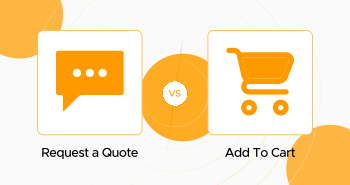
Not all Web stores need to be like retail markets. There are significant differences between business-to-business purchasing and consumption. Business buyers demand flexibility, negotiation, and personalization, but not immediate checkout. By using an “Add to Cart” approach in business-to-business stores, businesses are likely to experience confusion, which may, in the end, lead to conversion problems.

The Failure of “Add to Cart” in B2B Commerce
“Add to Cart” is a model with assumptions that are not common in the B2B e-commerce space. “Add to Cart” assumes fixed prices, small orders, and instant payments with no negotiation required. This may be acceptable in the consumer space, but not when dealing with businesses. Businesses would expect price customization, discounts for larger orders, flexible payment options, and the option to negotiate prior to purchase.
When consumers are presented with inflexible paths at the point of purchase with no room for negotiation, one of two things typically happens. They either choose not to visit the website at all, or they work around it by contacting the business directly. Neither option allows the online experience to facilitate the consumer’s purpose.
Challenges with “Add to Cart” Button for B2B Stores
- The pricing structure seems rigid and fixed, which deters genuine buyers.
- The customers would not be able to clarify any doubts about the purchase, customization, or details.
- High intent can lead to prospects abandoning instead of converting.
- It makes the Add to Cart feature inefficient for both the buyer and the seller, reducing a lead-generating technique into a conversion deterrent.
B2B Pricing Must Accommodate
While in consumer e-commerce, pricing rarely remains constant, in the case of B2B pricing it almost always fluctuates. This may be based on several factors, including quantities being ordered by the customer. Suppose a customer wants to purchase ten pieces. One can bet their last buck that their expectations will be totally different from those of a customer buying a thousand units.
Posting a fixed single quote ignores this side and may raise incorrect assumptions about inflexibility and even a lack of expertise in processing business transactions. Request a Quote maintains pricing flexibility and still acknowledges buyer intent. This gives sellers a chance to consider the context of the quote before providing a quote for their products’ worth.
B2B Request a Quote for WooCommerce Aligns You With Buyer Expectations
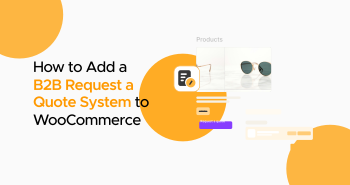
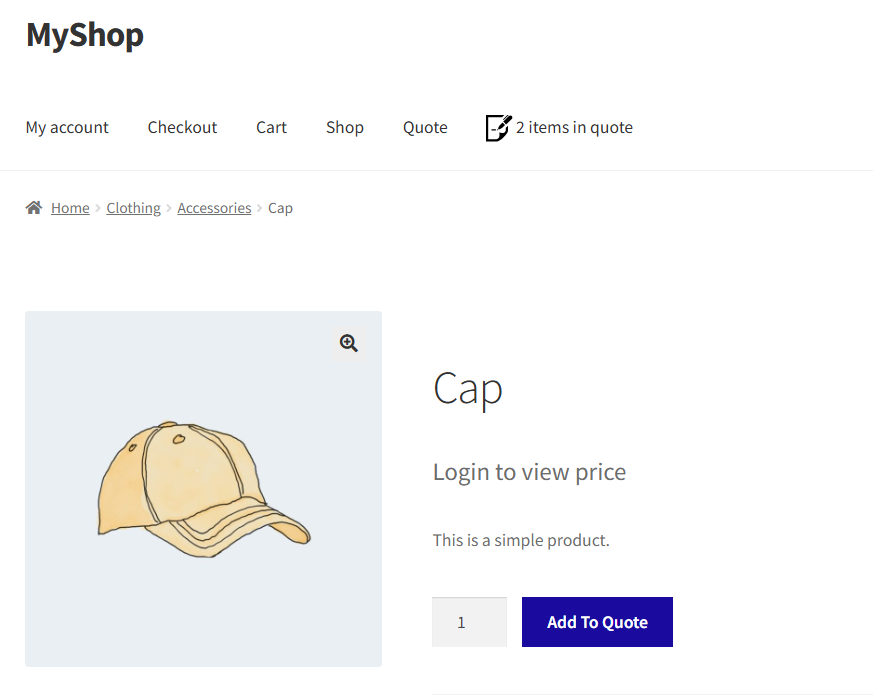
“Checkout” is not what the B2B buyer is trying to achieve. Instead, the buyer is trying to determine a fit, a value, a reduction of risk. B2B Request a Quote for WooCommerce is a plugin that provides you with a complete quotation system for your store. It enables you to easily put a get a quote button, providing a natural and user-friendly experience.
The moment buyers land on your website and click the ‘Request a Quote’ button, they signal their interest. But before proceeding, they would like to have a discussion. Such action enables a less cumbersome entry point in the process of sales.
When buyers make a request for a quote, they essentially mean the following:
- They are interested in
- They are truly interested in either the product or the solution
- They demand a pricing structure suited to their requirements
- They are receptive to a discussion prior to a decision being reached
This attitude promotes quality interaction and productive sales talks.
More Qualified Leads, Not Just More Visitors
Quote-based systems are most attractive because of the quality of their leads. “Add to Cart” activities are often motivated by curiosity rather than purchasing intention. It is not uncommon to see users click the “Add to Cart” button to ask about the price of the item or the cost of delivery.
A quotation request involves some work. The customer must provide their contact information, state their requirements, and describe their needs. This is a small hurdle that eliminates people with less intention of using the service and ensures that only potential clients, who are actually testing a purchase, send their requests.
Here, salespeople get less time to deal with non-qualified leads and have time to interact with potential clients interested in converting.
Suitable for High Price or Complex Products
With products that are costly or custom, displaying prices can sometimes have a negative effect. Some consumers may see a price and be hesitant, skeptical, or dismiss the whole idea immediately. With the “Request a Quote” button, businesses can discuss the extent, functionality, and customization before displaying the price.
This strategy can be critical for those types of goods that require setup, integration, training, or ongoing support.
Negotiation Enhances the Process of B2B Sales
In fact, negotiation is not a pitfall in B2B sales; it’s something your potential clients will easily assume. Buyers seek a price adjusted for volume, loyalty, and partnership opportunities. In fact, a quote-driven business model enables better negotiation while preserving margins.
Rather than letting opportunities slip away as a result of pricing, companies can react accordingly to offers. This allows a higher rate of conversion to happen. And this is particularly the case for consumers who believe they are treated fairly.
With “Request a Quote”, Companies Can:
- Offer volume-based or tiered discounts
- Upselling related products or services
- Pricing based on the relationship value and deal size
These kinds of options are rarely possible while using the Fix Price – Add to Cart model. If you’ve made up your mind to switch from “Add to Cart” to “Add to Quote,” install B2B Request a Quote by WPExperts now.
Right now, there’s a new year sale live for all the necessary WooCommerce add-ons. With the code: NEWYEAR26, you can get 26% off on your favorite WordPress plugins by WPExperts.
More Professional Buying Experience
Whether or not you believe, perception definitely plays a vital role in the B2B market. The retail storefront model could potentially hurt credibility, particularly if the company sells complex, industrial, or enterprise-level solutions. Impulse purchasing isn’t exactly the kind of purchasing decision the typical B2B enterprise requires.
“Request a Quote” bleeds professionalism, customization, and a serious attitude towards the purchase. This impresses the customer with the company’s understanding of the complexities involved in a buying decision and its willingness to take the customer through the entire sales process.
When Request a Quote Makes Sense
The “quote-based” method will be more applicable to wholesalers, bulk, customized, or high-priced products. This model is even more relevant when your pricing structure varies with the quantities sold, customization, delivery terms, and customer type. If your offline shopping experience includes discussion and negotiation, your online experience should be similar.
Some businesses that will most benefit from Request a Quote are:
- Wholesale and Bulk Suppliers
- Custom or Made-to-Order Manufacturers
- B2B Service Providers
- Vendors of enterprise software or high-value solutions
In this scenario, “Add to Cart” tends to restrict growth rather than facilitate it.
Final Thoughts
Throughout, “B2B selling focuses more on trust, adaptability, and long-term relationships than speed and automation.” Although the “Add to Cart” button was optimized for retail efficiency, it did not consider the complexities involved in business purchase decisions.
“Request a Quote” aligns with B2B buying behavior by fostering dialogue, preserving pricing strategy, and generating better leads. By adopting a quote-driven approach, B2B e-stores offer a natural buying process and a professional, intentional buying journey.
In some cases, less can actually mean more when it comes to sales, and for many B2B businesses, “Request a Quote” is the way forward. Get B2B Request a Quote for WooCommerce now, and watch your sales touch the sky.