











































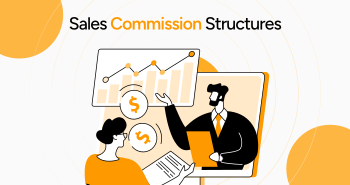
A business’s sales commission structure is crucial to its long-term growth and success overall. Therefore, businesses, either small or large, should opt for the proper sales commission structure. Besides, they should not take half measures when hiring the best sales representatives for their sales departments.
An impactful sales team helps businesses achieve their long-term goals by consistently attaining sales targets.
This blog post will describe the sales commission structure and its different types.
What Do You Mean by Sales Commission Structures?
If you don’t know about the sales commission structure, don’t worry. A sales commission structure indicates how businesses, whether large or small, compensate their sales representatives for performance overall.
In reality, businesses usually consider base salaries to offer representatives peace of mind and financial stability. Besides, they tend to provide substantial commission rates, encouraging sales representatives to perform well and earn significant amounts.
Any sales commission rates and structure you opt for your business will directly affect your reps’ earning potential. Therefore, you must ensure that they are designed to make benchmarks related to commission paid on sales attainable and certainly rewarding.
8 Sales Commission Types You Should Know
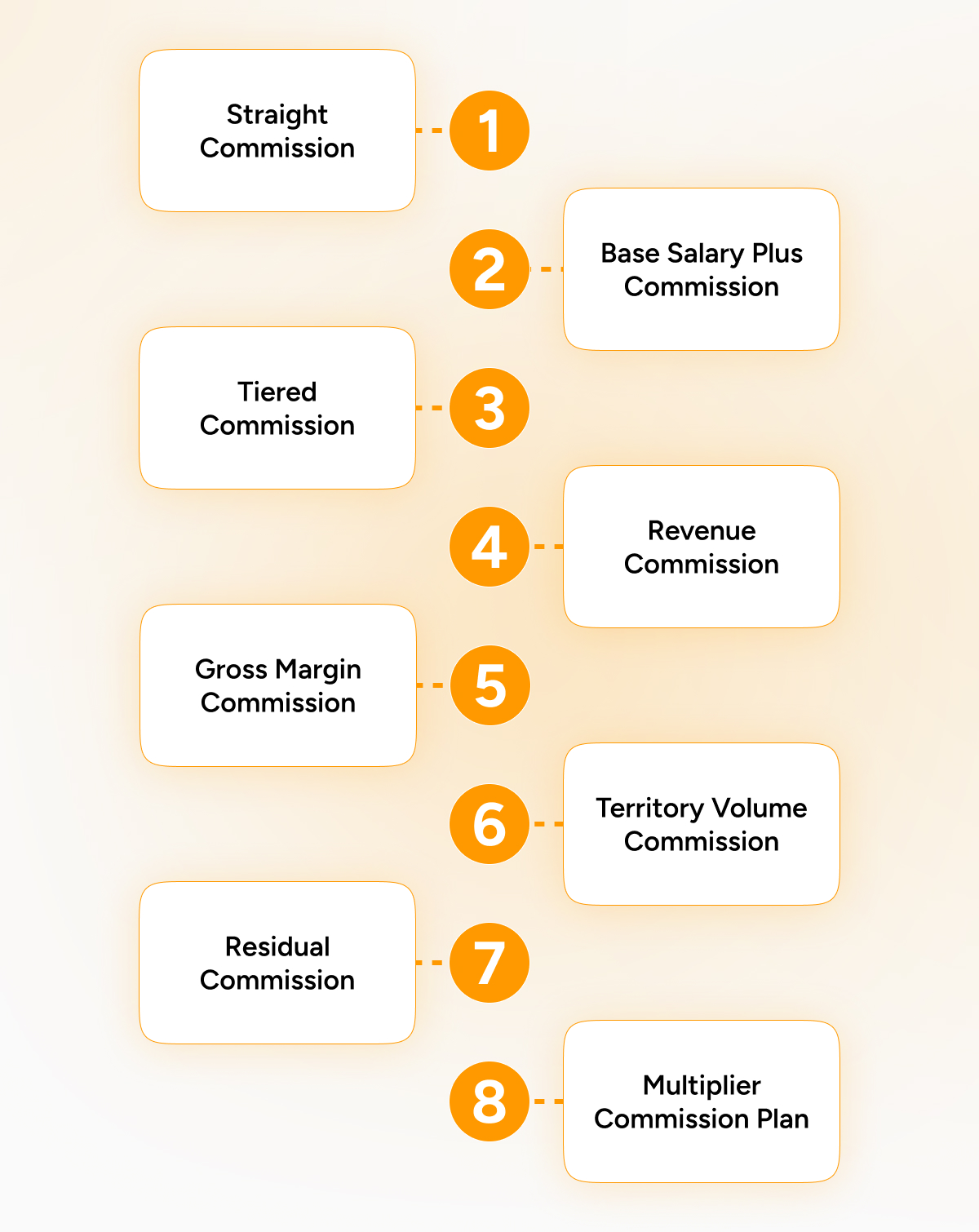
This section will discuss some of the most prominent sales commission structures available to B2B sales teams:
1. Straight Commission
A straight sales rep commission contradicts a base rate-only structure. Sales reps do not receive any salary or hourly wage. Unfortunately, they make money by generating sales. As a result, the commission usually received is much larger compared to other types of commissions.
However, they need to demonstrate the desired level of expertise to close as many deals as possible, which come their way. Using a straight commission structure can benefit small and large B2B businesses.
They can assume commission-only reps as independent contractors. This means they can save money on taxes, benefits packages, and other expenses incurred when employing in-house reps.
2. Base Salary Plus Commission
Base salary plus commission, as the name suggests, is self-explanatory. Sales representatives receive commission when they make sales in addition to a predetermined salary or hourly wage.
This is one of the most common commission-based sales structures since it assigns equal responsibility to employers and their sales reps.
3. Tiered Commission
If your reps require some encouragement, utilize a tiered sales commission structure. Through this sales compensation structure, reps achieve higher commissions once they mature a particular number of deals, generate a certain amount of revenue, or reach another milestone.
4. Revenue Commission
If your business implements a revenue commission structure, your sales representatives will earn a set commission for each sale they make. This is a renowned sales commission structure that suits outside sales teams and businesses selling products and services with fluctuating price points.
5. Gross Margin Commission
The gross margin commission structure works similarly to the revenue commission structure we explained earlier. The difference is that reps attain commissions on profit rather than revenue.
Gross margin commission models mainly entice reps to sell products with the maximum possible profit margins. There is no point denying that it has become one of the simplest ways for reps to improve their income.
6. Territory Volume Commission
The territory volume commission calculates commissions based on the success (or lack thereof) of whole geographical regions, i.e., territories. For that reason, territory volume commission structures are suitable for sales departments and teams that work closely with other teams.
7. Residual Commission
The residual commission structure ideally suits SaaS businesses, agencies, consultancy firms, and other entities that heavily depend on subscription models or recurring businesses.
This commission structure helps businesses offer sales representatives commissions as long as their accounts keep generating revenue.
8. Multiplier Commission Plan
There is another type of sales commission structure that businesses must be aware of: the multiplier sales commission plan. This plan helps businesses formulate custom compensation structures, encouraging their reps to accomplish more.
The multiplier commission plan allows businesses to pay a standard commission percentage. Sales heads or managers can multiply this percentage by predetermined numbers depending on each rep’s level of success.
How to Select the Right Sales Commission Structure for Your Business?
We hope you now understand different types of sales commission structures. It is high time to select the right commission structure for your business. When choosing the appropriate commission structure, you must consider various factors to make an informed decision.
Assess Your Business’s Goals
Firstly, you must decide what you want to achieve after putting in all the hard work. Moreover, your potential commission structure should have all the ingredients to inspire the sales representatives and help them attain their targets.
That said, the crux is to be specific here. If your main motto is to make deals in massive numbers, you must grind deep. Likewise, you must concentrate on how you can help your sales reps hit specific sales numbers.
Check Sales Reps’ Job Descriptions
Your sales department has many people who work according to specific job descriptions assigned to them.
This is because usually sales representatives are not required to carry out the same tasks as sales managers do. If you outsource a sales rep’s team, they will likely have diversified job descriptions.
Use a Remarkable Sales Commission Solution to Boost Sales Commission Structures
Sales Agent for WooCommerce suits online businesses of different volumes and target markets to effortlessly manage sales agents, monitor performance, and revolutionize commission payouts. They can benefit from various helpful features, including sales announcements, custom sales reports, sales agent dashboards, commission payout management, affiliate link generation, and real-time messaging. These features help make their overall sales generation and management processes results-driven.
Wrapping Up
Creating effective yet results-driven sales commission structures is a long-term activity that needs dedication, correct direction, and continuous improvement. In this situation, businesses must examine their current goals.
Besides, businesses must consult with their best sales reps to understand what motivates them to achieve their sales targets and other overall objectives. How do they overcome the gulf between incentives or facilities and success? They should not overlook their feedback at any cost, as it can allow them to devise an appropriate sales commission structure in the long run.
The near-perfect commission structure will be a hybrid that combines the pros of all the above models and builds on the effectiveness of multiple approaches and scenarios.