


























If you’re managing multiple WordPress sites, you would know that the struggle is real. Multiple logins. Multiple dashboards. Repeated plugin updates. Themes to maintain. Backup headaches. Worst of all, everything seems scattered. Enter WordPress Multisite.
It’s natively provided by WordPress (Multi WordPress Sites), allowing you to manage several WordPress sites from a single installation and central server.
It keeps them clean and prevents them from being scattered across your desk, your computer screen, or the vast expanse of the internet. In this article, we will describe some reasons to use WordPress Multisite, what it is, and how it works, along with good times to use it and not-so-great times.
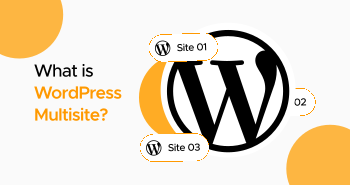
What is WordPress Multisite (or “Multi WordPress Sites)”?
WordPress Multisite is a feature of WordPress that lets you create a network of sites under a single installation. You install WordPress one time → enable Multisite → and from there, you can create as many subsites as your heart desires.
These subsites:
- Share the same WordPress core
- Share the same themes
- Share the same plugins
But they are still independent sites when it comes to:
- Pages and posts
- Media uploads
- Site-specific settings
- Local admins
So you get the best of both worlds — shared structure, then different content.
Why Some People Refer to It as “Multi WordPress Sites”
The term Multi WordPress Sites refers to a system for managing multiple WordPress sites in an orderly manner. So, instead of installing WordPress 10 times, you set it up once and then create 10 subsites within the same network. Down the line, WPMU (WordPress Multi-User) was replaced and killed off; it was an old feature that did something similar.
How WordPress Multisite Works (Behind The Scenes)
While this platform appears neat on the outside, it is indeed an all-in-one package from the inside, too.
Shared vs Separate Resources
Shared across all subsites:
- WordPress core files
- Installed themes
- Installed plugins
This cuts down on space and makes it easy to update.
Separate for each subsite:
- Posts and pages
- media libraries site-specific uploads folder for each site
- Database tables: wp_2_posts, wp_3_options, etc.
- Site-specific settings
This way, the content remains clean and isolated.
Super Admin vs. Site Admin
When you use multisite, it adds a new type of user called Super Admin.
Super Admin oversees the whole network:
- Add new subsites
- Install plugins/themes
- Control network-wide settings
Site Admin appears to only control their own sub-site:
- Publish content
- Manage users for that site
- Edit settings within the limit
This tiered control is appropriate for companies, departments, and schools.
URL Choices: Sub-Domains, Sub-Directories, or Domain Mapping
Type of subsite: You have three different formats for the way you can create a subsite:
Subdirectory (example.com/site1/)
- Neat, clean, and good in small or internal networks.
Subdomain (site1.example.com)
- Ideal for larger networks or organized groups.
Domain Mapping – site1 .com, site 2.com
- You give each subsite its own domain, but everything is still managed under one Multisite install.
Benefits of Using WordPress Multisite
You may think, What is the reason to use Multisite rather than separate installations? The main advantages are the following:
1. Centralized Management
You update your plugins, themes, and WordPress core once, and it updates for all subsites.
2. Consistent Design and Branding
Because themes are inherited, all subsites can have the same look and feel. Ideal for franchise chains, groups of schools, or large corporations.
3. Lower Resource Usage
You aren’t saving duplicates of the same themes and plugins, so the cost to host stays lower.
4. Easy to Scale
Need a new site? Create one in seconds. This is gold for agencies, universities, and media companies.
5. Centralized User Control
A single Super Admin maintains order, and we’ll give individual Admins access only to their own sites.
When You Should Use WordPress Multisite
Multisite is amazing for very specific types of applications. Use it when:
- Your sites are connected together. Some or all of your sites belong to the same organization
- You want consistent design or features between sites
- You want a single dashboard for everything
- You want it to scale across tons of locations over time
- You’re overseeing branch, regional, or language editions of your site(s)
- You are an agency working on multiple microsites for campaigns
If your websites are thematically related to one another in any way at all, Multisite is an excellent choice.
When Not To Use WordPress Multisite
Multisite is a little heavy-handed, and it’s not for everyone.
Avoid Multisite if:
- Your sites are completely unrelated
- Every site requires completely different plugins or themes
- You’re looking for individual hosting on each site
- Either you want that kind of isolation for performance or for security reasons.
- You’d like to be able to move or sell a site separately
- You anticipate a lot of changes to each site.
Multisite, after all, keeps everything interconnected — which is desirable unless total separation is your goal.
Multisite vs. Multiple WordPress Installs (The Easy Explanation)
|
Factor |
WordPress Multisite |
Separate WP Sites |
| Access to dashboards | One master dashboard | One per site |
| Plugin/theme management | Install once, shared | Install for each site |
| Updates | One-off | Manual repeat |
| Resource usage | More efficient | More storage + overhead |
| Flexibility | Limited by shared code | Full freedom per site |
| Performance/Security isolation | Lower | Higher |
| Risk level | Assessments may affect all sites | Issues remain isolated |
| Best for | Related sites | Unrelated, custom sites |
Choose Assistance If You Need Help
It can be a bit of a tricky process if you’re not used to it. That’s where expert WordPress multisite services come in. They offer:
- Installing and configuring the Multisite setup
- Create subdomains or map the domain
- Optimize performance for large networks
- Ensure plugin compatibility
- Add custom roles or workflows
- Secure the entire network
- Manage ongoing maintenance
If you are working on a big network, franchise system, university site structure, or corporate network, then it might be worthwhile to hire some professional help so that you don’t spend more time fixing things in the future.
Conclusion
WordPress Multisite provides an intelligent, efficient way to manage multiple WordPress websites (or multi-WordPress sites) using the power and flexibility of a single WP installation. It keeps things organized, wipes out monotony, and gives stiff centralized control.
It’s not, however, perfect for everyone. It’s best for related sites with similar themes or branding. If your sites have nothing to do with each other, or you are doing heavy customization, separate installs may be a safer bet.
Take your time after reading this guide on what the WordPress Multisite feature is, then decide if you really need it or not.