

















































.NET has established a strong standing among programming languages and frameworks over the years. If we say its flexibility and robustness have played a key role in it, we are correct to a certain degree. Created by Microsoft, the .NET Framework provides a platform for building different kinds of applications. It allows developers to create powerful web and desktop apps for mobile and cloud-based solutions.
The .NET Framework is a dynamic developer platform that delights developers with numerous choices across distinct versions.
Let’s explore the journey through the .NET Framework version history and its effectiveness.
What Do You Mean by .NET Framework?

As a prominent software development platform, .NET Framework has made the lives of developers easier and impactful worldwide. Moreover, several powerful features, such as a vast class library and the Common Language Runtime (CLR), have contributed to the creation of engaging applications, including desktop, web, and mobile applications.
.NET Framework Version History (A Snapshot)
Here is the summary of different .NET releases, including the latest releases of the .NET Framework:
- The first version of the .NET Framework 1.0 was launched in February 2002.
- The .NET Framework 2.0 was unveiled in November 2005.
- The .NET Framework 3.0 arrived in November 2006.
- The .NET Framework 4.0 was released in April 2010.
- The .NET Framework 4.5 was unveiled in 2012.
- The .NET Framework 4.5.1 was published in 2013.
- The .NET Framework 4.5.2, a previous version of the .NET Framework, was made available in 2014.
- The .NET Framework 4.6 was issued in 2015.
- The .NET Framework 4.6.1 was released on November 30, 2015.
- The .NET Framework 4.6.2 was made available on August 2, 2016.
- The .NET Framework 4.7 was launched in May 2017.
- The .NET Framework 4.7.1 was unveiled on October 17, 2017.
- The .NET Framework 4.7.2 was released on April 30, 2018
- The .NET Framework 4.8 was launched in April 2019.
- The .NET Framework 5.0 was unveiled in November 2020.
NOTE: This marked the integration of .NET Framework and .NET Core into a solitary, unified platform.
- The .NET Framework 6.0 was released in November 2021.
- The .NET Framework 7.0 was launched in November 2022.
- The .NET Framework 8.0 (The latest version of the .NET Framework) was released in November 2023.
.NET Framework Version History (An Overview)
This section provides a detailed discussion of the current .NET version, as well as previous versions of .NET Framework.
| Versions | Release | CLR Version | Included in Windows | Included in Windows Server |
|---|---|---|---|---|
| .NET 4.8.1 | 2022-08-09 | CLR 4 | Windows 11 September 2022 Release (version 22621) | 2025 (Windows Server 2022) |
| .NET 4.8 | 2019-04-18 | CLR 4 | Windows 10 May 2019 Update | 2022 (Windows Server 2022) |
| .NET 4.7.2 | 2018-04-30 | CLR 4 | Windows 10 April 2018 Update (Version 1803) | Version 1803 |
| .NET 4.7.1 | 2017-10-17 | CLR 4 | Windows 10 Fall Creators Update (Version 1709) | Version 1709 |
| .NET 4.7 | 2017-04-11 | CLR 4 | Windows 10 Creators Update (Version 1703) | Not Included (Manual Installation Required) |
| .NET 4.6.2 | 2016-08-02 | CLR 4 | Windows 10 Anniversary Update (Version 1607) | 2016 |
| .NET 4.6.1 | 2015-11-30 | CLR 4 | Windows 10 November Update (Version 1511) | Not Included |
| .NET 4.6. | 2015-07-29 | CLR 4 | Windows 10 | Not Included |
| .NET 4.5.2 | 2014-05-05 | CLR 4 | Not Included (Manual Installation Required) | Not Included (Manual Installation Required) |
| .NET 4.5.1 | 2014-01-15 | CLR 4 | Windows 8.1 | 2012 R2 |
| .NET 4.5 | 2012-10-09 | CLR 4 | Windows 8 | 2012 |
| .NET 4.0 | 2010-04-12 | CLR 4 | Not Included | Not Included |
| .NET 3.5 | 2007-11-19 | CLR 2.0 | Windows 7 | Not Included |
| .NET 3.0 | 2006-11-21 | CLR 2.0 | Vista | Not Included |
| .NET 2.0 | 2006-02-17 | CLR 2.0 | Not Included | Not Included |
| .NET 1.1 | 2003-07-10 | CLR 1.1 | Not Included | Not Included |
| .NET 1.0 | 2002-04-15 | CLR 1.0 | Not Included | Not Included |
The above .NET version list demonstrates the significance of the .NET Framework when increasing developers’ productivity and enhancing apps’ performance. Additionally, developers can leverage strong security features to improve the security of various applications.
Latest Versions of .NET Framework and Their Features for Small, Mid-Sized, and Large Enterprises
This dot net version history table comprises the features offered by the latest versions of .NET Framework for mid-sized, small, and large enterprises:
| Features | Small Enterprises | Mid-Sized Enterprises | Large Enterprises |
|---|---|---|---|
| Scalability | Flexible to diverse needs | Easily scalable for growth | Manages complex demands |
| Cost-Effectiveness | Budget-friendly development | Balanced cost-to-benefit ratio | Efficient resource utilization |
| Integration Capabilities | Easily integrates with tools | Seamless integration options | Robust integration support is available |
| Developer Productivity | Simplifies development tasks | Improves development speed | Offers support to large teams |
| Security Features | Sufficient for basic needs | Offers robust security protocols | Comprehensive security measures |
| Flexibility | Suitable for specific tasks | Adaptable to diverse needs | Accommodates diverse requirements |
| Cloud Readiness | Suited for cloud migration | Well-integrated with cloud services | Optimized for cloud environments |
| Community Support | Supportive developer platform community | Agile community contributions | Enterprise-level support |
| Customization | Tailored to specific needs | Effortlessly customizable solutions | Offers intricate customization |
| Long-Term Support | May rely on community support | Reliable long-term support | .NET for Enterprise-grade support |
What is the Most Recent .NET Framework Version?
The most recent or updated version of the .NET Framework is 4.8.1. As you know, .NET Framework 4.8.1 was launched in August 2022, it is assumed as the last major version of .NET Framework, with future development focusing on the newer .NET platform. .NET 5 (and following versions, such as .NET 6, .NET 7, .NET 8, and the existing .NET 9) is the suggested path for new development and is a cross-platform, open-source successor to .NET Framework.
Old Versions of .NET Framework
The .NET Framework started its journey in the early 2000s. Similarly, the first version (.NET Framework) was launched in February 2002. Likewise, other versions, such as .NET Framework 2.0, were released in November 2005. Furthermore, the .NET Framework 3.0, the previous version of .NET, was launched in November 2006.
The dot net framework version history is inspiring and fruitful for developers, motivating them to create out-of-the-box applications over time.
What is the History of .NET Framework?
The .NET Framework is a brainchild of Microsoft. In other words, Microsoft is the mastermind behind the evolution of the .NET Framework. The idea was proposed in the late 1990s under the umbrella of “Next Generation Windows Services” (NGWS) as a part of Microsoft .NET strategy.
As discussed, the first version of the .NET Framework, .NET Framework 1.0, was made available on February 13, 2002. The first beta edition or release of the .NET Framework was launched in 2000, delighting users with its key component: the Common Language Runtime (CLR). Moreover, the previous version of .NET offered support for object-oriented web application development.
.NET Framework Architecture
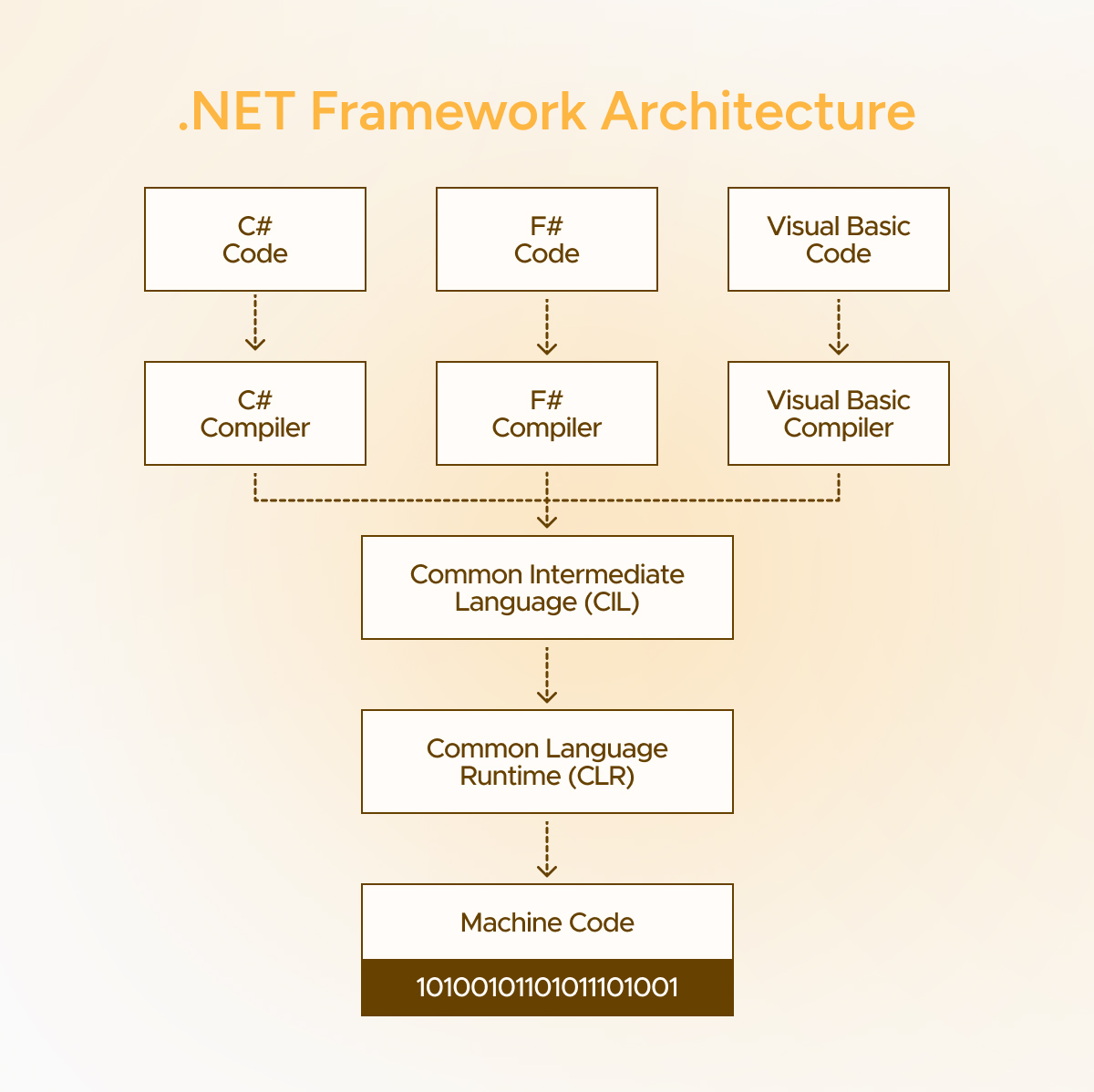
According to the dot net version history, the .NET Framework comprises two crucial components. These components include the Common Language Runtime and the .NET Framework Class Library.
Common Language Runtime (CLR)
The Common Language Runtime (CLR) primarily works as an execution engine that manages the execution of applications. It provides services such as thread management, garbage collection, type safety, exception handling, and more.
Class Library
The Class Library offers different types and a set of APIs for common functionality. Additionally, it provides types for strings, dates, numbers, and more. The Class Library contains APIs for writing and reading files, drawing, linking to databases, and other related tasks.
Importance of .NET Latest Releases
All .NET releases have enabled businesses of all sizes to thrive in the digital era. They allow them to enhance security, technology integration, and cross-platform capabilities, ensuring optimal performance. In short, .NET helps businesses maintain their position at the forefront of technological progress.
Technological progress aside, the role of Visual Studio is invaluable in enhancing the usefulness of the .NET Framework. As you might know, Visual Studio is a development tool that suits the .NET Framework and is arguably one of the top IDEs available globally. Therefore, developers can benefit from this impressive IDE and transform the impact of their projects to the next level.
For developers, grasping the characteristics of each .NET Framework version is crucial for making informed decisions. It enables them to fine-tune their current and potential projects based on their objectives and goals, ensuring that projects thrive or reach their full potential in the ever-changing technological sphere.
Therefore, developers should not underestimate the significance of dot net framework version history, as they can comprehend the characteristics of dot net framework versions and make full use of them when needed.
Wrapping Up
We hope you have liked our blog post detailing the .NET Framework version history. As a web developer working in a website development firm or agency, you cannot underestimate the significance of the .NET Framework at any cost.
Launched by a tech trendsetter and leader like Microsoft, the .NET Framework has become an excellent tool for developers over time.