


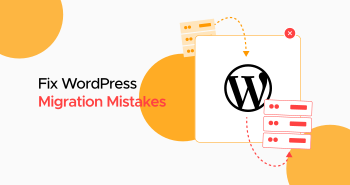











Migrating a WordPress site sounds straightforward on paper — just move files and databases, point your domain to the new host, and you’re done. But in real life, that move can go sideways quickly. Lots of site owners spend hours troubleshooting WordPress migration issues they caused because they thought it would be simple.
If you want to avoid headaches, you need to know the typical WordPress Migration Mistakes — and more importantly, how to solve WordPress Migration mistakes when they happen. Below are the five most common problems people run into — and what you can do to fix (or, better yet, avoid) them.
1. Skipping a Full, Verified Backup
This seems insignificant, but it’s the most frequent error. When you’re scrambling to complete a migration, this is the sort of thing that might go through your mind:
“I’ll back it up later,” or “It’ll be fine, nothing is going to happen?”
Why it’s a Big Problem:
If something is corrupted (a file, a database import) or there’s a plugin conflict, you could lose posts, settings, or even media. At best, you have nothing to show for it and feel defeated. At worst, you end up with a half-working site and no backup that will restore things to working order.
How to Correct it (or Avoid this WordPress Migration Mistake):
- Always do a full backup; files, database, and uploads all combined.
- Save in a secure location (away from the same server).
- Test that the backup can be restored in a staging / local environment to check if it works.
A good backup is your insurance against disaster. Skipping it is the quickest way to transform a migration into a disaster.
2. When You Ignore Server Differences (PHP, Hosting Limits, and Configurations)
Just because your old and new hosts look the same doesn’t mean they’re alike. Variations such as WooCommerce versions, PHP version, MySQL version, WordPress versions, memory limits, file size limits, or any other server-specific setup can cause your site to break right away.
These Mismatches Often Cause:
- 500 internal server errors
- Database connection issues
- White screen of death
- Broken plugins or themes
Resolve (Or Prevent) This WP Migration Problem:
- Make sure the new host meets the required PHP, MySQL, and WordPress versions.
- Your Wordpress website maintenance includes: Update of wordpress core, theme, plugins, and WooCommerce extensions before the move.
- For large websites, phpMyAdmin is not enough; use CLI tools or a more involved database.
Think of moving into a new house by migration: Even if it has the same layout as your old one, the wiring may be different. Always check compatibility first.
3. Forgetting to Fix URLs, Internal Links & Media Paths
This is one of the most common issues after a migration: The site loads, but images are missing, links go to the old domain, and some pages break.
Real-World Example of a Client Approached us to Solve their Legit WP Migration Issue:
As WordPress migration experts, we are approached by clients who have tried to migrate their WordPress site themselves. They almost did everything accurately, but they still ran into a serious WordPress migration issue:
They migrated their sites without caring about the URLs and internal links. After they finished their migration, their rankings dropped, their leads stopped coming, and their business began to fall apart. Only then do they understand they have made a mistake by trying to migrate to WordPress themselves.
Then they searched for a solution and found WPExperts’ migration services, and we helped them recover and resolve the WordPress migration issue they faced.
Why Does it Happen:
Many URLs are stored in the database, including posts, settings, widgets, theme options, and even serialized data. After migration, they still point to the old domain or HTTP instead of HTTPS.
How to Fix (or Avoid) this Mistake:
- Run a search-and-replace across the database to update old URLs to the new domain.
- Check your media library and image paths to ensure nothing broke during the transfer.
- If switching from HTTP → HTTPS, install and configure SSL properly.
Fixing URLs is a simple step, but ignoring it leads to broken images, missing files, and a very inconsistent user experience.
4. Forgetting to Reset Permalinks, Rewrite Rules, .htaccess, and Permissions
Once the migration is done, many people assume everything should just work. But WordPress has to “refresh” its internal rules quite often: the permalink structure, the .htaccess, and filesystem permissions. If you don’t do that, it results in 404 errors, broken pages, or server errors when the migration is successful made.
This is a frequent kind of WordPress migration mistake that shows up just after migration, when you’re about to celebrate and go live.
Fix this WordPress Migration Mistake:
- Go to Settings → Permalinks, and just hit “Save Changes.” That regenerates rewrite rules.
- If this fails to resolve the issue, regenerate or recompile the .htaccess file. One old-school trick is to rename the current file to something like .htaccess_old, and then tell it to rewrite the new .htaccess for you.
- Make sure file permissions and directory privileges are appropriately configured on the new server (especially for uploads and theme/plugin folders). Misconfigured permission settings frequently prevent file access or uploads.
A few quick clicks and you can repair URLs or address issues before they surprise you.
5. Skipping Post-Migration Testing — or Going Live Too Fast
This is the slipperiest of WP migration mistakes we’ve seen in our digital journey. Many people migrate, point to the domain, and think they’re done. Only to discover later that forms don’t work, CSS is missing, plugins fail, or pages load slowly.
Why Thorough Testing Matters:
Some migration issues aren’t apparent at first glance. You might miss bugs that affect SEO, conversions, or user experience.
How to Fix (or Avoid This WP Migration Mistake):
- Put the site in maintenance mode before migration to avoid new changes during the move.
- After migrating, test:
- pages
- posts
- navigation
- forms
- media
- plugins
- mobile responsiveness
- third-party integrations (analytics, SMTP, CDN, caching)
- Compare speed and performance with the old site.
A couple of hours of testing is far better than days of debugging after launch.
Quick Migration Checklist
|
Stage |
Tasks |
| Before Migrating | ✔ Full site backup
✔ Confirm new server requirements ✔ Update WordPress core, theme, and plugins ✔ Enable maintenance mode |
| After Migrating | ✔ Run search & replace for URL fixes
✔ Regenerate permalinks and .htaccess ✔ Fix file/folder permissions ✔ Test everything (pages, forms, speed, SEO, plugins) ✔ Monitor performance for a few days |
Final Thoughts
Now you know that migrating your WordPress site isn’t as complicated as defusing a bomb. It means that when you treat it with care (proper backups, attention to compatibility, keen URL management), you can move your site without incident.
If we look at it as a rule, the most significant problems are not so much behind WordPress. It is mostly caused by rushing in or skipping over steps, taking migration for granted. The approach we just discussed will help you in preventing the typical WordPress migration errors. And not only that, but also learn how to fix WordPress Migration mistakes if they do arise.
After all, a mindful, incremental move like relocating one’s house respectfully will keep your site alive and kicking. It’ll be fully operational and open regularly to welcome visitors.