
































 Usman Hayat
In today’s era, security is of utmost significance as everything tends to become digital. We are committed to safeguarding our accounts, identities, and data as much as possible from hackers, attackers, and other cyber threats. Two of the most crucial protocols that users may benefit from when bypassing security issues are 2FA vs MFA.
There is no denying that understanding the difference between Two-Factor Authentication (2FA) and Multi-Factor Authentication (MFA) has become a necessity for anyone seeking online security and anonymity. This blog post will discuss the differences between these protocols, 2FA and MFA, in detail.
What is 2FA?

2FA or Two-Factor Authentication is a method where users are verified with the help of two factors. The first factor is usually a password, which is known to users. The second option could be something they already have, like a token or a smartphone, to authenticate or validate a user’s claimed identity.
What makes 2FA effective is that it introduces a barrier, creating challenges or hurdles for threat actors to misuse users’ accounts in the event of password leakage.
What is MFA?
Multi-factor authentication (MFA) is a robust authentication method that encourages netizens to offer two or more pieces of evidence when authenticating or confirming their identities. MFA comprises two or more authentication methods, including OTPs, passwords, hardware tokens, biometrics, or other sorts of authentication.
Key Attributes of 2FA
- It needs two diverse forms of authentication, such as knowledge-based (e.g., username/password) and something users have (e.g., a token or code sent via SMS).
- It helps provide an extra layer of security to users.
Key Attributes of MFA
- It needs two or more forms of authentication, like a knowledge-based factor.
- It also offers a supplementary layer of security and is more impactful than 2FA in terms of security.
- Businesses can use it to safeguard accounts and data from unauthorized access.
- It helps offer security to users against malicious attacks, such as phishing.
- It allows businesses to control access to several applications and systems.
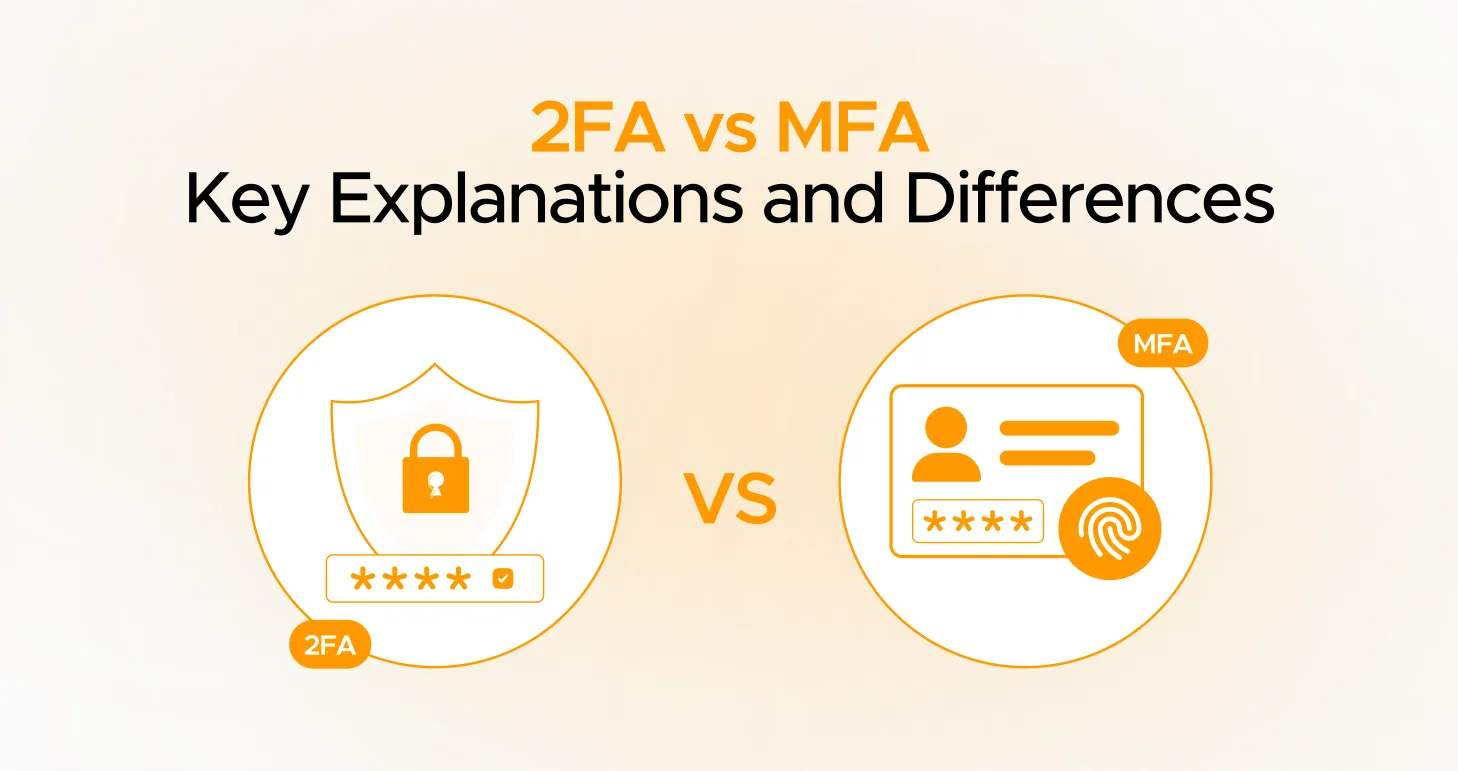
The above 2FA vs MFA illustration indicates that businesses need to use these security protocols to improve the security of their users’ data and other crucial information.
What Are the Differences Between 2FA vs MFA?
If we specifically discuss 2FA, this authentication method or approach is more secure than OTPs. That’s because it needs two diverse factors. Moreover, 2FA is considered cumbersome for cybercriminals to hack than 1FA. In reality, 2FA relies on more than one approach to authentication.
Similarly, MFA resembles 2FA to a certain degree. However, there is a distinction between the two authentication measures. When verifying users’ identities, it utilizes more than one method of verification. For instance, MFA contains a combination of several technologies, including email addresses, hardware keys, mobile apps, and more.
Key MFA vs 2FA Differences (A Summarized Table)
| Characteristic | 2FA (Two-Factor Authentication) | MFA (Multi-Factor Authentication) |
|---|---|---|
| No of Factors | It needs two factors of authentication. | It needs various factors of authentication. |
| Explanation | When proving identities, it uses two factors of authentication. It usually utilizes a password and OTP or SMS. | When confirming identities, it relies on more than two factors of authentication. It usually depends on biometrics, hardware keys, passwords, mobile apps, and more. |
| Security Level | It is more beneficial than 1FA (One-Factor Authentication). | It offers an extra layer of protection by using various verification methods. |
| Complexity | It is easier to use than MFA. | It is a cumbersome approach, but more effective than 2FA. |
| Typical Usage | It is used when users want to log into applications, sites, apps, and other online services. | It is used in high-security environments, such as government organizations, private companies operating in various sectors and industries, and enterprise-level systems. |
| Resistance to Hacking | Yes, it plays a crucial role in preventing security issues such as hacking and ransomware. It is more secure than 1FA. | It uses various levels of protection, increasing the online security of users considerably. Therefore, it also helps reduce multiple security issues, such as hacking, ransomware, and other cyber threats. It is more helpful and results-driven than 2FA and 1FA. |
The above MFA vs 2FA comparison indicates that both these security protocols help increase users’ privacy considerably. Therefore, businesses should use them in tandem when securing their confidential data from the prying eyes of hackers and other cybercriminals.
Implications of 2FA vs MFA for Businesses

2FA (Two-Factor Authentication) and MFA (Multi-Factor Authentication) are crucial security aspects that enable businesses of different sizes to safeguard their data against various security hazards.
According to the 2FA vs MFA comparison, both these authentication measures enhance users’ security through additional layers of protection. This helps authorized users access the resources they need without fuss.
From the businesses’ point of view, they can provide their employees with a near-perfect environment that is secure and adheres to the minimum security benchmark set by them. Doing so will also enable them to proactively tackle issues like data breaches, hacking, ransomware, data theft, and more.
Furthermore, from the customers’ perspective, the increased security can give the current and prospective customers peace of mind that their data is safe and not prone to any security risk. The above 2FA and MFA differences reveal that businesses, whether small or large, must incorporate such security measures into their devices and systems on an immediate basis.
MFA Market Current and Future Growth Worldwide
The international MFA market will continue to prosper in the coming years; at present, it will reach USD 14.61 billion in 2025. It will reach USD 23.64 billion by the end of 2033, progressing at a CAGR (compound annual growth rate) of 6.2% in the same period.
What Does SSO Stand For?
As you might be aware, SSO is the formal abbreviation of Single Sign-On. Single sign-on (SSO) is an identification approach, similar to MFA and 2FA, that enables users to log in to multiple sites and applications with a single set of credentials. SSO software simplifies the users’ authentication process, similar to 2FA and MFA.
Why is SSO Crucial for Online Security?
SSO is one of the easiest yet most impactful authentication methods that provides users with a single sign-on access to several services. Interestingly, users can efficiently utilize only one set of credentials when accessing multiple services.
Businesses should not overlook the significance of SSO since it helps them minimize the risk of password fatigue alongside other issues like weak or compromised passwords. It enables netizens to access various applications with a single set of credentials, simplifying and making the login process more productive for them.
Are SAML and MFA the Same?
FYI, SAML and MFA are not identical by any stretch of imagination. That said, they mostly work in parallel. As far as SAML is concerned, it is a Security Assertion Markup Language, which typically functions as a standard that helps exchange authorization and authentication data among various systems.
Remember, these different systems are utilized mainly for SSO (Single Sign-On). MFA is a security measure that compels users to offer multiple forms of identification to access a system.
What is 2SV?
After conducting the 2FA vs MFA comparison, you should also understand 2SV. 2SV, also called two-step verification, is an additional layer of online protection. As a substantial security feature, users can enhance their online accounts’ security to the next level with the help of 2SV. Hackers and other unwanted users cannot access your accounts, even if they manage to locate your account passwords.
Wrapping Up
Undoubtedly, 2FA and MFA provide users with desired levels of security at all times. As for 2FA, it primarily works as a biometric scan or a one-time code. Simply put, it functions as a second form of authentication for users.
On the other hand, MFA largely depends on various levels of authentication, ensuring users remain secure and safeguarded, regardless of the devices or systems they use online. These technologies help offer users secure yet reliable authentication systems.