







































 Abdullah Ashraf
Claude vs. ChatGPT analysis is a valuable learning experience for those looking to benefit from both platforms. This revolution began when OpenAI introduced ChatGPT in November 2022. Not to forget that Anthropic’s Claude emerged in the market a few months later in March 2023.
As a result, users started comparing Claude with ChatGPT to determine which model was more suitable for them.
This blog post provides a detailed analysis of Claude vs. ChatGPT, explaining the distinct attributes of generative AI models.
What’s the Difference Between Claude and ChatGPT?
The table below highlights the key differences between Claude and ChatGPT:
| Features | Anthropic Claude | OpenAI ChatGPT |
| Primary Strengths | Coding, research, long-form writing, data analysis, web search, voice conversations, and interactive Artifacts. | Coding, research, multimodal analysis, image generation, real-time voice, web search, and agentic tool workflows. |
| Coding & Development | Claude Code operates in the terminal, browser, and supported IDEs. Artifacts can create interactive apps and visualizations, while code execution supports analysis and file creation. | ChatGPT supports coding through chat, Canvas, and Codex. Codex operates across ChatGPT, IDEs, terminals, and cloud environments. |
| Image and Voice | Analyses image inputs and creates diagrams or interactive visuals, but does not natively generate conventional photos or illustrations. Includes two-way voice mode. | Analyses and generates or edits images. Includes real-time voice conversations. |
| Web Search | Native live web search and web fetching with citations; also offers a Research feature. | Native web search and deep research with citations and source links. |
| Unique Tools | Artifacts, Claude Code, Projects, connectors and Research. | Canvas, Codex, custom GPTs, Projects, deep research and image generation. |
| Pricing & Plans | Free; Pro at $20/month or $200/year; Max plans at $100 and $200/month. | Free; Go; Plus at $20/month; Pro tiers at $100 and $200/month. Business and Enterprise plans are also available. |
Claude vs ChatGPT for Coding
According to this ChatGPT vs Claude analysis, Claude beats ChatGPT by some distance. As you may be aware, Claude has Opus 4.8 and Claude Code, which help orchestrate the most powerful coding workflow.
The Claude Code studies project files, handles git branches, executes test suites, and edits code. Hence, developers can enjoy this liberty.
As for ChatGPT, it leverages OpenAI Codex, which runs in cloud sandboxes and supports faster setup but comes at the cost of reduced developer control over the environment. Moreover, Codex works in parallel with GitHub Copilot and VS Code; it is the cherry on top for developers already in that ecosystem.
For developers who prefer a hands-on coding partner who works in their terminal, Claude Code is a good fit. If you’re looking for autonomous, cloud-based task execution with robust IDE integration, OpenAI Codex is a strong choice. For most developers who perform routine engineering tasks, Claude is a reasonably suitable option.
Claude vs ChatGPT for Writing
Writers indicate that Claude smartly generates natural, nuanced prose. Whereas ChatGPT abides by instructions literally and generates clean but formulaic output. The good thing that favors Claude is that it likely varies sentence structure, considers edge cases in topics, and occasionally pushes back with a better approach.
Claude does help process a complete research paper, manuscript, or documentation set in a single conversation. Interestingly, while doing all this, Claude maintains coherence in subsequent responses.
ChatGPT isn’t a poor option for writing. It is reliable and speedy, and it does exactly what you ask. ChatGPT is perfectly capable of generating quick content, social media posts, and structured templates.
For long-form articles, nuanced analysis, academic writing, and anything requiring voice and depth, Claude regularly helps both experienced and novice writers achieve impressive results.
Where Claude Has an Edge Over ChatGPT?
Claude excels at advanced document processing, nuanced reasoning, and serving as an autonomous workspace rather than just a chatbot.
Though both models are impactful, Claude serves various specific purposes, including:
- Workspace Integrated Previews (Artifacts): When Claude creates code or helps produce designs, it renders them in a live, side-by-side preview panel (Artifacts). You can evaluate a calculator, see a data visualization, or make changes to diagrams without viewing a static code block.
- Desktop & Workspace Autonomy (Cowork): Claude works as a productivity agent that can operate directly on your desktop computer. It helps users run apps, manage files, and conduct scheduled tasks to automate workflows (e.g., aggregating daily reports). It is well suited to non-technical knowledge work.
- Massive Context Synthesis: Claude lets users upload up to 20 large files (PDFs, spreadsheets, code files) simultaneously, allowing it to cross-reference and extract contradictions across multiple complex documents.
- Human-Oriented Writing: Users regularly discover that Claude’s writing prevents common AI clichés. Moreover, it has been trained to push back on faulty logic or bad ideas, whereas ChatGPT usually agrees with the user to sustain a positive tone.
- Step-by-Step Reasoning: For coding, complex logic, mathematical proofs, or other difficult tasks, Claude’s detailed reasoning process walks you through its reasoning step by step.
On the contrary, ChatGPT offers features that Claude needs to improve, such as built-in image generation and voice and conversational capabilities.
Claude vs ChatGPT Pricing
Both Claude and ChatGPT offer users different pricing plans that meet their diverse needs. The table below offers comprehensive details covering various pricing packages provided by Claude and ChatGPT:
| Plan | Claude | ChatGPT |
| Free | Free access with usage limits, including web search, file creation, code execution, memory, and other core features. | Free access with limited GPT-5.5 Instant usage and limited access to messages, uploads, image creation, deep research, Codex, and other tools. |
| Pro / Plus | Claude Pro: $20/month or $200/year—equivalent to about $17/month. Includes more usage, additional models, Claude Code, Research, and other advanced features. | ChatGPT Plus: $20/month. Includes higher limits, GPT-5.5 Instant, GPT-5.6 reasoning, expanded Codex, deep research, image creation, and other advanced features. |
| Max / Pro | Claude Max: from $100/month, with either 5× or 20× more usage than Claude Pro. | ChatGPT Pro: $100 or $200/month, with respectively 5× or 20× the usage allowance of ChatGPT Plus. |
| Team / Business | Claude Team: Standard seats cost $25/user/month or $20/user/month billed annually. Premium seats cost $125 monthly or $100/month billed annually. Minimum two users. | ChatGPT Business: $25/user/month or $20/user/month billed annually. Minimum two users. |
| Enterprise | Claude Enterprise: $20 per seat, billed annually, plus usage charged at API rates. Includes additional enterprise administration, security and compliance controls. Self-serve and sales-assisted options are available. | ChatGPT Enterprise: customized pricing with enterprise security, administration and support options; contact sales. |
API Pricing for Developers: Pay-As-You-Go
In addition to their regular subscription plans, Anthropic and OpenAI provide APIs for developers. These APIs allow developers to integrate Claude or OpenAI models into websites, applications, chatbots, coding tools, and automated workflows without relying on the Claude or ChatGPT consumer apps.
API access is billed separately from Claude and ChatGPT subscriptions. Instead of paying a fixed monthly fee for app access, developers generally pay according to the number of tokens processed by the API.
How Token-Based Pricing Works
Tokens are the small pieces of text that an AI model reads and generates. As a rough guide, 1,000 tokens are equal to around 750 English words. This is only an estimate, though. The actual number can change depending on the language, punctuation, formatting, subject matter, and the tokenizer used by the model.
API providers normally charge separately for:
- Input tokens: The prompt, instructions, conversation history, documents, and other information sent to the model.
- Output tokens: The response generated by the model.
Input and output prices are different, with output tokens generally costing more. The prices below are listed in US dollars per one million tokens.
Claude API Pricing
Anthropic offers several Claude models for different performance, speed, and cost requirements.
| Tier | Model | Input per 1M Tokens | Output per 1M Tokens | Typical Use Case |
|---|---|---|---|---|
| Specialized Frontier | Claude Fable 5 | $10.00 | $50.00 | Long-running agents and highly complex autonomous workflows |
| Advanced | Claude Opus 5 | $5.00 | $25.00 | Complex agentic coding, enterprise work and advanced reasoning |
| Balanced | Claude Sonnet 5 | $2.00* | $10.00* | General-purpose applications requiring a balance of speed and intelligence |
| Efficient | Claude Haiku 4.5 | $1.00 | $5.00 | Fast, economical applications and high-volume workloads |
Claude Fable 5 is Anthropic’s highest-capability generally available model, while Claude Opus 5 is positioned for complex coding and enterprise work. Sonnet 5 balances speed and intelligence, whereas Haiku 4.5 is designed for faster and more cost-efficient workloads.
*The $2 input and $10 output rates for Claude Sonnet 5 are introductory prices available through 31 August 2026. Beginning 1 September 2026, the standard price will be $3 per million input tokens and $15 per million output tokens.
Developers should also be careful when estimating Claude usage from word counts. Claude 4.7 and later models use a newer tokenizer that may produce approximately 30% more tokens for the same text than earlier Claude models. Anthropic therefore recommends counting tokens using the exact model intended for the application.
OpenAI API Pricing
OpenAI’s API also follows a usage-based pricing structure. Developers can select a model according to the level of intelligence, performance and cost required by their application.
| Tier | Model | Input per 1M Tokens | Output per 1M Tokens | Typical Use Case |
|---|---|---|---|---|
| Flagship | GPT-5.6 Sol | $5.00 | $30.00 | Complex professional work, advanced reasoning and coding |
| Balanced | GPT-5.6 Terra | $2.50 | $15.00 | Production applications requiring a balance of intelligence and cost |
| Efficient | GPT-5.6 Luna | $1.00 | $6.00 | Cost-sensitive applications and high-volume workloads |
OpenAI recommends GPT-5.6 Sol for complex reasoning and coding, GPT-5.6 Terra for balancing capability and cost, and GPT-5.6 Luna for efficient, high-volume applications.
Important Pricing Considerations
The figures above represent standard token prices. The final API cost may vary based on factors such as:
- Cached input and cache-write pricing
- Batch or alternative processing options
- Long-context requests
- Regional or data-residency processing
- Web search, file search, code execution and other paid tools
- Cloud-provider pricing
- Future model or pricing updates
For example, OpenAI applies higher rates to GPT-5.6 requests containing more than 272,000 input tokens, while eligible regional-processing endpoints may include a 10% price increase. Anthropic offers separate rates for prompt caching, Batch API processing, fast mode, and regional processing.
Therefore, developers should review the official API pricing documentation and calculate expected input, output, and tool usage before deploying an application at scale.
Claude vs. ChatGPT for Image Generation
ChatGPT is the clear winner here as it helps integrate GPT Image (built on DALL-E technology) directly into conversations. As a result, users can easily produce images, edit them, add text overlays, create marketing assets, and iterate visually. For all these tasks, they do not have to leave the chat.
Sadly, Claude does not have the capacity to create top-notch images, as it isn’t a native image generator. That said, it can help improve image design workflows.
But again, if you plan to make visual content creation a key part of your workflow, ChatGPT is the more reliable option.
ChatGPT vs. Claude AI for Voice and Conversation
ChatGPT’s advanced voice mode delivers natural-sounding, real-time voice conversations, with adequate emotional expressiveness and support for interruptions.
On the other hand, Claude has also started offering a conversational voice mode. It benefits from basic text-to-speech, is perceived as slow and clunky, and can cut off during conversation.
ChatGPT can process audio intelligently and help users speak effortlessly while driving, cooking, or walking, taking conversations to the next level. Claude needs to improve its voice and conversation performance.
Note: Users can’t access voice mode on desktop because OpenAI has removed this feature from the ChatGPT macOS desktop app. They can continue enjoying the facility on web and mobile devices (iOS/Android).
Claude vs. ChatGPT for Internet Access
Do you know that ChatGPT’s web browsing is deeply integrated with Bing, enabling it to search the web, extract live data, cite sources, and answer questions regarding current events mid-conversation? Yes, it is true. Moreover, it feels seamless and natural.
Users can benefit from Claude’s search tool, but its effectiveness could be improved. That’s because it offers limited web access, so they cannot use it to its full potential. It is not as convincing and powerful as ChatGPT’s browsing.
If you want to work on activities that need real-time information — stock prices, recent product releases, news, weather — ChatGPT is a superior option.
ChatGPT vs. Claude for Context Window
ChatGPT and Claude assist users who want to use up to 1 million tokens. Claude Opus 4.8 and GPT-5.5 now support 1M tokens. Thus, users can smartly load detailed docs or whole codebases into a unified conversation.
However, both models can fulfill users’ requirements, but it depends on how smartly ChatGPT or Claude uses long context for users’ benefit.
Claude vs. ChatGPT Reddit
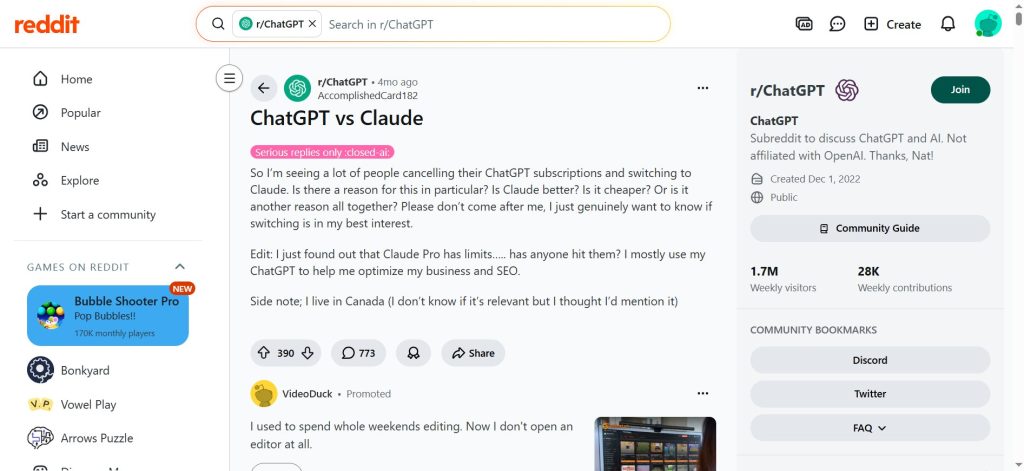
Redditors have clearly voiced their opinions regarding the Claude vs ChatGPT discussion. According to some users, Claude looks more natural than ChatGPT. For coding and other complex, technical tasks, Claude works better.
If you are specifically interested in creating high-quality images, ChatGPT is way ahead. Likewise, another user reported that Claude has helped them with various projects.
Compared to ChatGPT, Claude offers users a more positive vibe, whereas ChatGPT lacks that, another user noted.
The above ChatGPT vs Claude AI debate suggests that the former needs to improve its performance to match the latter. Overall, Claude appears to be a more advanced, powerful, and results-driven option than ChatGPT.
Both Claude AI and ChatGPT Apps Now Deliver Agentic AI Features
Agentic coding is a hallmark of ChatGPT and Claude AI. Claude, like ChatGPT, offers products that help with work beyond coding, from organizing files to booking a dentist appointment.
Claude’s agentic product, Cowork, is accessible via Claude’s desktop app for macOS and Windows. Cowork works directly on users’ file systems: it directs them to a folder, describes the desired outcome, and lets Claude map out specific steps and execute them.
For instance, Cowork can obtain data by exploring a folder containing dozens of PDFs and converting them into a spreadsheet. In reality, it works like a digital employee that performs tasks while residing in the background. Cowork is a game-changer, fostering true collaboration.
ChatGPT agent typically operates on the web and, instead of collaborating with the user’s computer’s file system, uses a virtual browser to explore websites, fill out forms, click buttons, and take actions on users’ behalf. It supports various online tasks, such as data scraping, research, and travel booking.
ChatGPT released workspace agents, which you can consider the next generation of custom GPTs. It helps you create agents. In addition, you can share agents with your team so they can manage and optimize complex workflows in the background.
When to Choose Claude
- Writing Quality: Claude generates prose that looks deeply human, avoiding the robotic, bulleted “AI-isms” that characterize ChatGPT.
- Coding & Data Analysis: Claude’s “Artifacts” feature develops interactive, side-by-side windows for live coding, visualizations, and dashboards.
- Document Processing: It offers a gigantic context window for uploading long PDFs, books, or whole codebases.
When to Choose ChatGPT
- Creative Brainstorming: ChatGPT helps you explore broad, out-of-the-box ideas and generate raw material before you narrow your focus.
- Image Generation: It natively supports DALL-E for top-notch image creation. Claude lags in this area.
- Ecosystem & Tools: ChatGPT integrates web browsing, file conversion, and plugins into a single workspace, making it a comprehensive one-stop shop.
- Voice Interactions: ChatGPT’s voice mode is extremely advanced, providing low-latency, conversational audio.
Wrapping Up
We hope you liked our detailed Claude vs ChatGPT analysis. There is no denying that ChatGPT and Claude aren’t exchangeable or interchangeable. They inspire users with a wide range of compelling features and advantages. For instance, Claude is well-suited to technical tasks like coding, reasoning, and more.
You can use Claude provided you are willing to work with large contexts. As for ChatGPT, it is well-suited to tasks like image creation, voice, integrations, browsing, and other routine assistance.
In this situation, you should take a combined approach, using both generative AI models to explore which option best suits your needs. In short, whichever option you go with, you will definitely benefit from an impressive AI assistant.
FAQs
Is Claude better than ChatGPT?
Claude and ChatGPT are better at performing specific tasks. The question depends on what you want from both of these generative AI models. Therefore, users’ demands and preferences practically determine the effectiveness of ChatGPT or Claude.
Why do people prefer Claude AI?
People generally prioritize Claude AI for its highly conversational, nuanced, and human-like tone, paired with strong capabilities in complex problem-solving and coding.
How can I tell if I am chatting with an AI bot?
If you chat with an AI bot, you’ll find overly perfect grammar, inhumanly fast response times, and an annoyance when it answers absurd questions (like asking how to cook a moon rock). Humans tend to use slang, make mistakes like typos, and understand humor and emotional nuance.
What are ChatGPT’s biggest competitors?
Different generative AI models pose a challenge to OpenAI’s ChatGPT, including Google Gemini, Claude, Perplexity AI, and DeepSeek.
Which is better, Claude vs ChatGPT, for everyday use?
Claude and ChatGPT are impressive AI tools for everyday use, but they excel in distinct domains: Claude looks like a real deal when it comes to writing and analysis, while ChatGPT seems to be a more versatile, feature-rich assistant.
Which is better, Claude vs ChatGPT, for studying?
Consider ChatGPT if your studies involve coding, heavy math, or quick Q&A. Select Claude if you want to write papers, examine dense academic texts, or study the humanities. Most students also follow a hybrid approach. They use ChatGPT for problem-solving and Claude for deep reading.