































 Muhammad Jaffer
Beginning a wholesale business sounds interesting, doesn’t it? It’s not as difficult as you believe. Millions of individuals make money purchasing goods in bulk and reselling them to retailers and other companies. The secret lies in recognizing the various types of wholesalers and determining which wholesale business best suits you.
Imagine wholesaling like this: A company produces 100.000 mobile phones. They don’t sell one phone to 100,000 different individuals. They sell phones in chunks to different mobile phone wholesalers in the market. The wholesaler resells those phones to 20 different phone stores. So much more convenient for all!
But here’s something that most folks are not aware of – there are various methods of doing wholesale business. From which we will learn the top 8 different types of wholesalers today. Each method functions differently and generates money differently. Once you grasp the different wholesalers’ types, you can decide which one fits your skills and budget best.
What Is Wholesaling Really
Keep this simple. Wholesaling involves purchasing large quantities of goods at one time (referred to as “bulk buying”) and selling these smaller quantities to other companies. You act as the middleman between businesses that produce things and businesses that sell them to the general public.
Why do firms require wholesalers? Because a soap manufacturer doesn’t want to have 500 little shops demanding 10 pieces of soap each. They prefer selling 5000 bars to one wholesaler and being done with them.
The 8 Different Types of Wholesalers You Should Know
In an evolving and growing wholesale world, it’s essential to be aware of the most common types of wholesalers before starting your business.
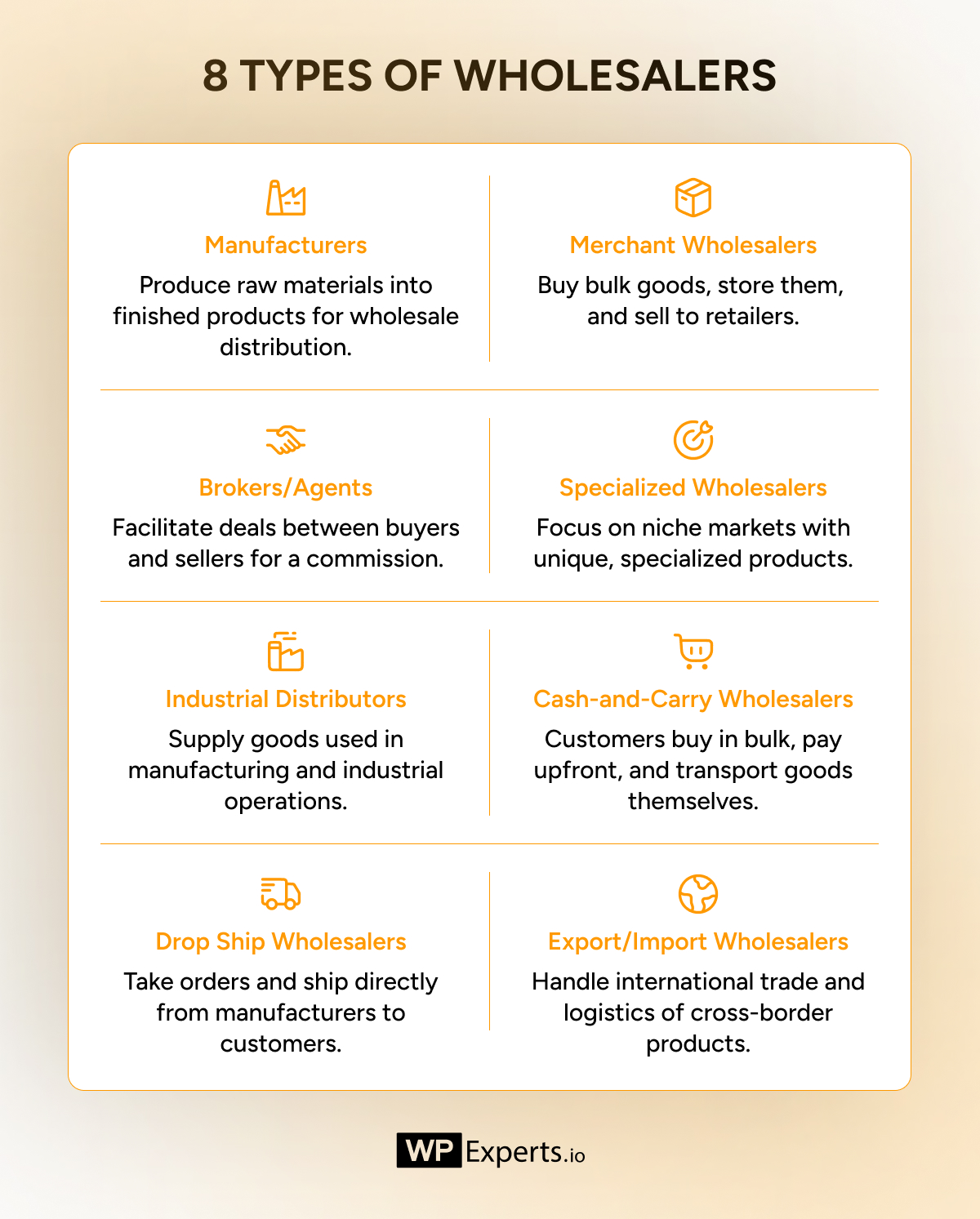
1. Manufacturer Wholesalers
These are businesses that manufacture products and sell them directly to stores. Rather than employing a middleman, they do both manufacturing and selling.
Example: An organization produces camping tents in its manufacturing plant. Rather than selling to another wholesaler, they sell to outdoor equipment stores directly.
- Why this works: They get to keep all the profits and set their prices.
- Why it’s challenging: Having a factory AND a sales force is costly and complex.
- Best for: Individuals who already have manufacturing companies.
2. Merchant Wholesalers
Most people picture a wholesaler when they hear the term “Merchant Wholesalers.” They initially buy or import goods from factories/industries/manufacturers. They then warehouse them and supply them to retail outlets in smaller amounts.
Example: You bring in 1,000 LED TVs and keep them in your warehouse, and sell 50 to one wholesaler/retailer and 30 to another, and so on.
- Why this works: You can purchase or import just what you want and when you want.
- Why it’s hard: You have to have money up front to purchase inventory and pay for storage space.
- Best for: Individuals with some capital to invest and strong business connections.
3. Broker/Agent Wholesalers
These are wholesale matchmakers. They do not purchase or hold anything. They simply introduce manufacturers to stores and collect a fee when transactions occur.
Example: A shirt maker has to find places to sell their shirts. A broker brings them to 10 stores that sell clothes, facilitates sales, and takes 5% of each sale.
- Why this works: Low startup costs because you don’t purchase inventory.
- Why it’s difficult: Your earnings rely on closing deals.
- Great for: People skilled at networking and forming relationships.
4. Specialized Wholesalers
These wholesalers specialize in only one kind of product or sector. They turn into the premier experts within their field.
Example: A wholesaler that specializes in selling medical equipment exclusively to clinics and hospitals. They understand everything about medical equipment and rules.
- Why this works: You can sell expert knowledge for more money.
- Difficulty: If your chosen industry fails, your entire wholesale business dies.
- Recommended for: Individuals with specialized knowledge or expertise in any industry.
5. Drop Ship Wholesalers
These wholesalers never handle the products they sell. If a store orders something, the drop shipper instructs the manufacturer to have it shipped directly to the store.
Example: An online store sells customized phone cases. When someone places an order for a case, the drop shipper has the manufacturer ship it directly to the customer.
- Why this works: No inventory expenses or storage required.
- The challenges are: Thin profit margins and limited shipping control.
- It’s perfect for: People who wish to start with low startup costs.
6. Export/Import Wholesalers
An import wholesaler purchases products from foreign countries or markets and resells them domestically. An export wholesaler purchases products domestically and resells them internationally.
Example: An individual imports electronics from Japan and retails them to electronics shops in America.
- Why this works: Exposure to foreign goods and possibly greater profit margins.
- Why it’s challenging: Complicated documentation, shipping delays, and currency exposures.
- Ideal for: Individuals who are familiar with international trade.
7. Industrial Distributors
These wholesalers sell commodities that businesses utilize to produce other products – such as tools, raw materials, and machinery components.
Example: A distributor that sells steel, welding equipment, and safety equipment to construction firms.
- Why this succeeds: Companies always require supplies to continue operating.
- Why it’s difficult: The difficulty lies in the technical expertise required to explain industrial products.
- Best for: Those with manufacturing or construction experience.
8. Cash-&-Carry Wholesalers
These function similarly to warehouse stores, where the customers enter, select what they wish, and pay cash immediately.
Example: A warehouse where restaurant owners purchase bulk quantities of food supplies and pay for them immediately.
- Why this works: Easy operation and instant payment.
- Expected difficulty: Connecting with customers who pay in cash for bulk orders.
- Suggested for: Individuals seeking wholesale solutions that are both low-maintenance & handy.
How Technology Promotes Wholesale
This is the best part, which comes just after discussing the different types of wholesalers. You previously required massive warehouses and sophisticated systems to operate a wholesale business. No longer is this the case. Nowadays, technology, particularly online tools, has revolutionized everything.
The biggest game-changer is WooCommerce, particularly with its suite of extensions for wholesale. This allows you to set up a professional wholesale website without having to be a tech expert. Here’s what this does for your business (top 3 benefits of having an online Wholesale business):
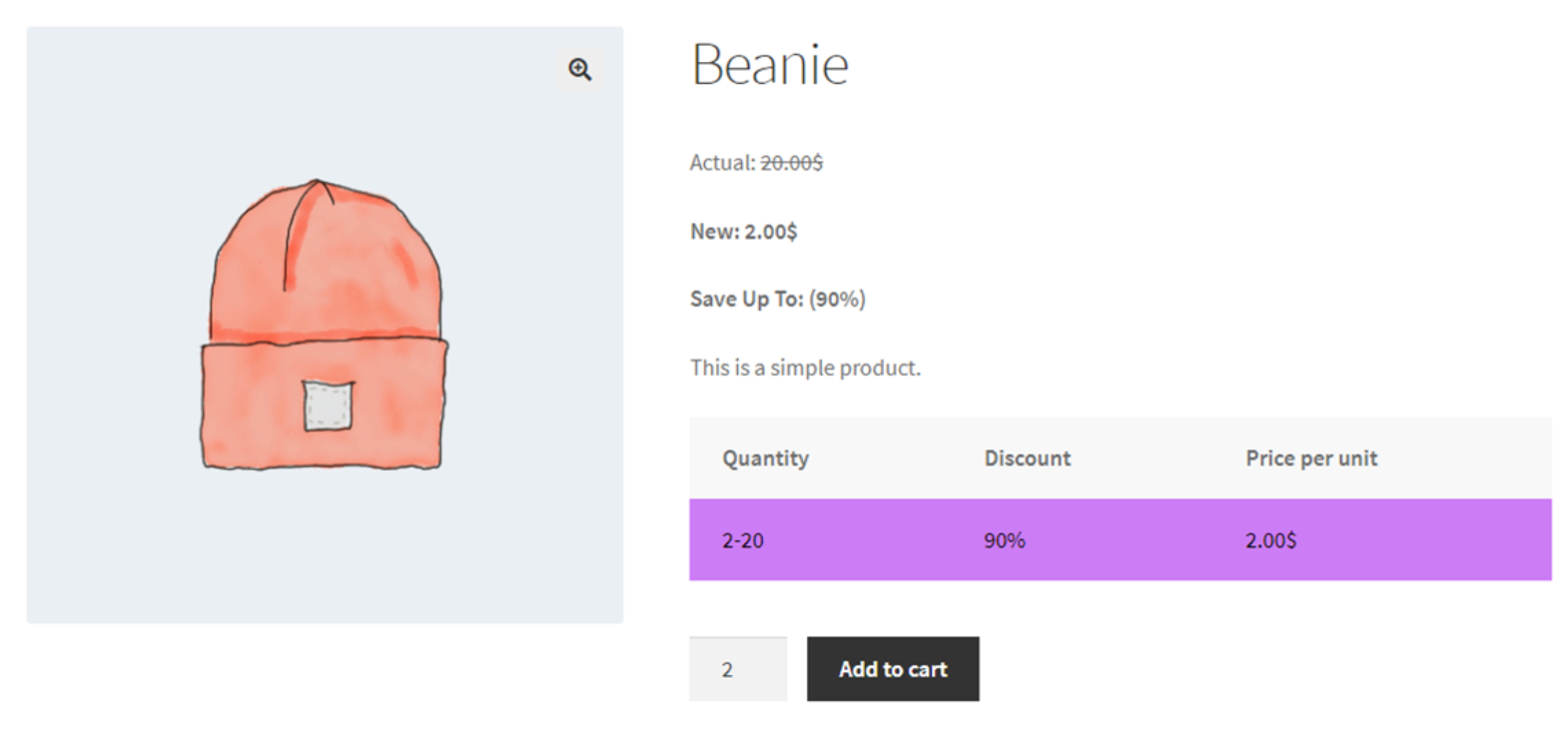
– Smart Pricing
Rather than having to compute various prices for various customers yourself, the system does it for you. Giant customers receive bulk discounts, while small ones see either normal prices or the price you set. And you don’t have to keep track of anything yourself; a complete wholesale system handles it for you.
– Easy Ordering
Customers can submit bulk order forms for large purchases, avoiding the need to add hundreds of items one by one to the shopping cart. It now takes just minutes, which used to take hours.
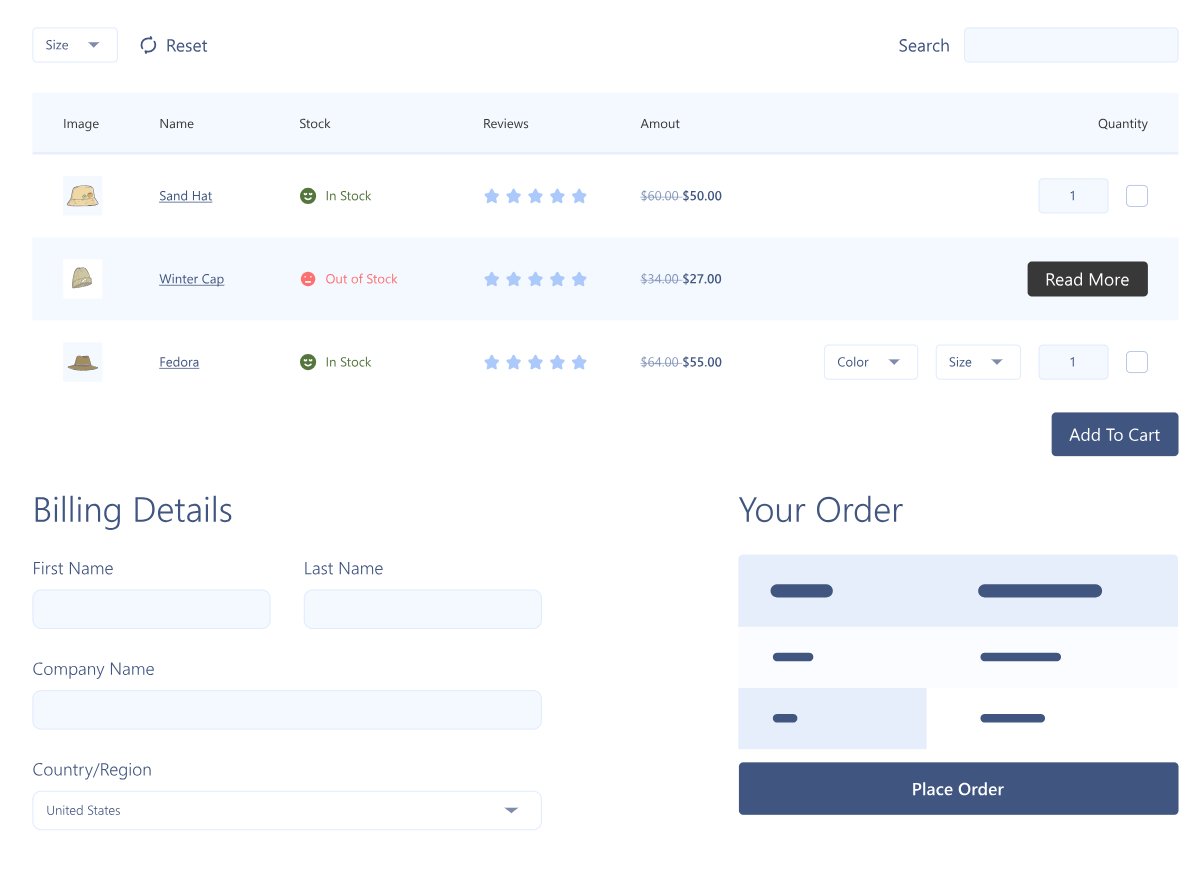
The online wholesale software automatically categorizes your customers into groups, displays them the correct prices, and manages their registration and approval: Bye-bye spreadsheets and manual tracking.
– Professional Look
Your wholesale business appears just as professional as that of any large company, even if you’re operating it from home.
Why Modern Wholesale Tools Are Important
Suppose you’re interested in beginning to sell office supplies to businesses. Here’s why modern tools matter:
– Order Management: Then vs. Now
- Old style: Company A receives a 15% discount, Company B receives a 20% discount, and Company C receives special rates on paper products. Each order needed to be calculated by hand.
- New style: Program the rules once in your system. When clients log in, they automatically receive their proper prices. Orders execute themselves.
– Simplifying the Ordering Process: Old Way vs. New Way
- Old way: When a business wanted to order 50 different office products, they’d call you or email a long list. You’d manually enter everything and calculate totals.
- New way: They use a bulk order form to select quantities for all products they want quickly. The system handles everything else.
This isn’t just convenient – it’s what customers expect now. Businesses are used to ordering online with automatic pricing and instant confirmation.
How to Start Wholesaling
Achievement in wholesaling begins with accurate self-evaluation. Study your capital on hand, industry contacts, and operating experience before engaging in any business format. Every wholesaling strategy requires varying investment and skill levels.
Research various distribution channels thoroughly and evaluate which platforms align with your financial capacity. This groundwork determines whether you’ll thrive as a specialized distributor, general merchant, or service-based broker in today’s competitive marketplace.
Select from the Different Types of Wholesalers for Yourself
With eight possible wholesaler types, how do you decide? Ask yourself these questions:
| Questions to Ask | Low Budget | Medium Budget | Higher Budget |
|---|---|---|---|
| How much capital can you begin with? | Experiment with Broker/Agent or Drop Shipping | Look at Specialized or Internet Wholesaling | Consider Traditional Merchant Wholesaling |
| What are you naturally skilled at? | People skills: Broker/Agent Wholesaling | Industry knowledge: Specialized Wholesaling | Organization: Traditional Merchant Wholesaling |
| How much risk is acceptable? | Lower risk: Broker/Agent or Drop Shipping | Medium risk: Specialized Wholesaling | Increased risk: Old-Fashioned Merchant or Import/Export |
Start Wholesaling with Your WooCommerce Store
The B2B wholesale market is experiencing phenomenal growth, with projections to reach $36.16 trillion by 2026 (Source: SellersCommerce). And your WooCommerce store can tap into this opportunity today. With businesses increasingly seeking reliable wholesale suppliers online, there’s never been a better moment to expand into B2B commerce.
Introducing to you: Wholesale for WooCommerce – an all-in-one WooCommerce extension that transforms your current store into a flourishing B2B wholesale business.
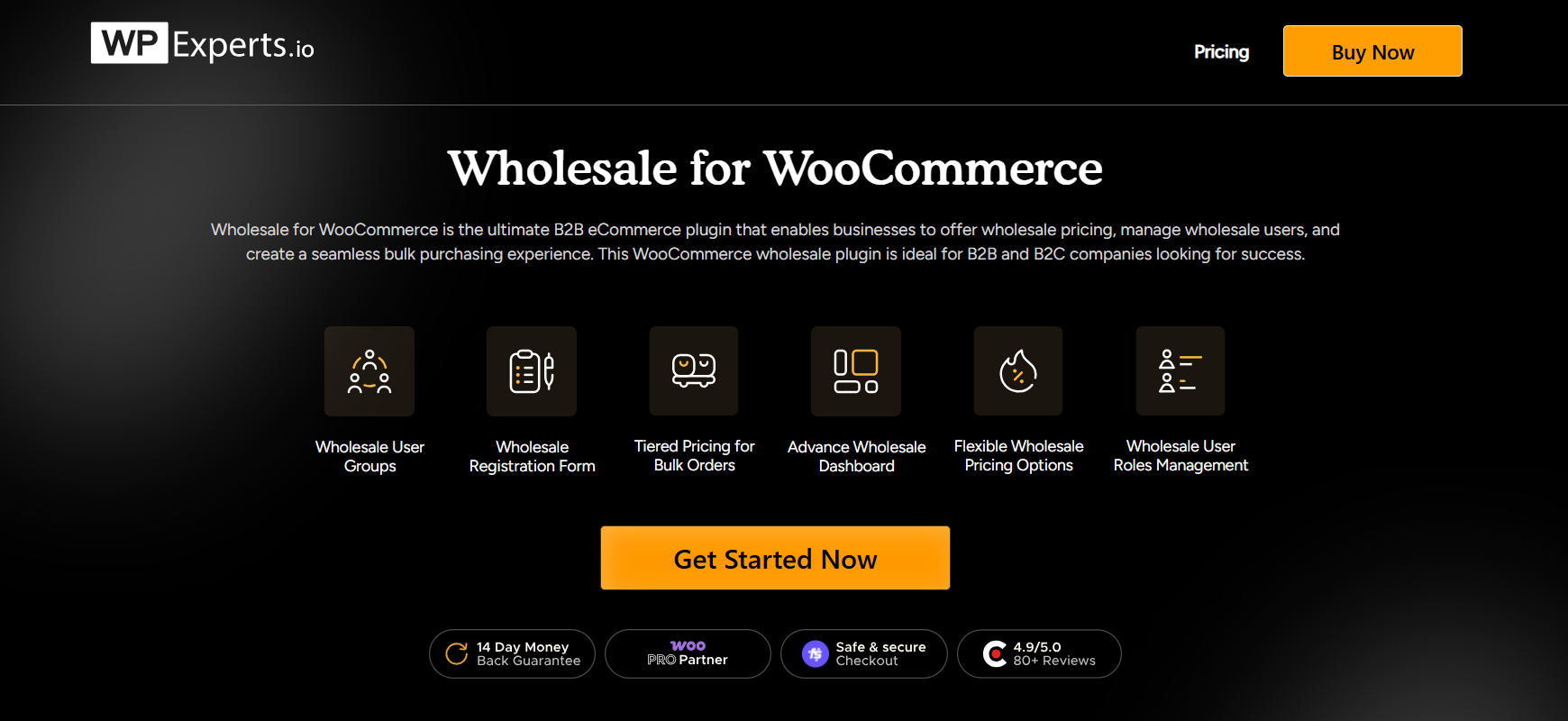
This is not like other WooCommerce extensions or non-professional B2B platforms that make the process complicated. Wholesale for WooCommerce simplifies B2B selling, making it just as easy as regular retail.
Why Wholesale for WooCommerce Stands Out:
Wholesale for WooCommerce is packed with features that make wholesaling simple for the different types of wholesalers worldwide.
- Create Exclusive Wholesale Experiences Instantly
Build custom user groups with unique pricing tiers, set minimum order quantities, and even offer tax exemptions for qualified wholesale buyers – all from one place.
- Streamline Bulk Ordering Like Never Before
Your wholesale customers will appreciate the variation tables and requisition lists, which make placing large orders quick and painless. No more back-and-forth emails about bulk pricing!
- Grow your B2B Customer Base on Autopilot
Streamline customer acquisition by implementing automated registration systems that incorporate verification protocols and spam protection. Implement approval processes that categorize prospects based on creditworthiness and their potential for order volume. Transform qualified leads into repeat customers through systematic onboarding procedures.
- Offer the Payment Flexibility B2B Buyers Expect
Modern B2B buyers demand flexible payment terms tailored to their cash flow cycles. Establish multiple payment channels that accommodate different business models – from immediate settlement options for smaller retailers to extended net terms for established enterprises. Customize shipping arrangements according to customer requirements and geographical constraints.
With features like tiered bulk pricing, private wholesale stores, and even product sampling capabilities, Wholesale for WooCommerce isn’t just another plugin – it’s your gateway to B2B success. Join thousands of store owners who’ve already discovered how easy wholesale can be when you have the right tools.
Frequent Mistakes to Avoid Before Starting Wholesaling
What others learn the hard way can save us time and money if we avoid them:
- Doing too much too quickly: Select one wholesale model and become an expert at it before scaling up.
- Ignoring technology: Customers demand updated, user-friendly ordering experiences. Don’t attempt to operate a wholesale business like it’s 1995.
- Underestimate costs: Any wholesale model comes with unforeseen costs. Plan for more than you anticipate.
- Bad customer service: One unhappy wholesale customer can cause the loss of thousands of dollars (bucks) in future orders.
- Not monitoring numbers: Get to know your profit margins, best customers, and bestselling products.
Most wholesale businesses start great but fail quickly because their owners lack a clear understanding of their finances. Be a smart one, do your research, and equip yourself with all the necessary B2B armor to conquer your rivals.
Wrapping Up: The B2B (Wholesale) Future Looks Bright
The wholesale business today shows incredible strength across several channels. Combining e-commerce, global supply chains, and digital infrastructure presents unprecedented marketplace possibilities. Individual businesses now possess resources formerly available only to multinationals. It enables them to offer competitive pricing and service quality comparable to larger firms.
Whether specializing in vertical markets, simplifying manufacturer-retailer connections, or managing traditional distribution models, current market conditions favor new wholesale entrants. Established players face disruption from agile competitors who leverage technology and prioritize customer relationships over conventional operational approaches.
Take a moment to reflect on the 8 top wholesale business options we discussed. What sounds most appealing to you? What fits your circumstances? When you are ready, choose one and start making your wholesale business a reality.
Keep in mind that all successful wholesalers began exactly where you start now – with a vision and the desire to learn. Tools like Wholesale for WooCommerce by WPExperts are available to help you succeed.
The market opportunity is real. The only thing left to ask now is: are you ready to begin?
Download the Wholesale for WooCommerce extension now and transform your normal e-Commerce store into a B2B giant in your niche.