
































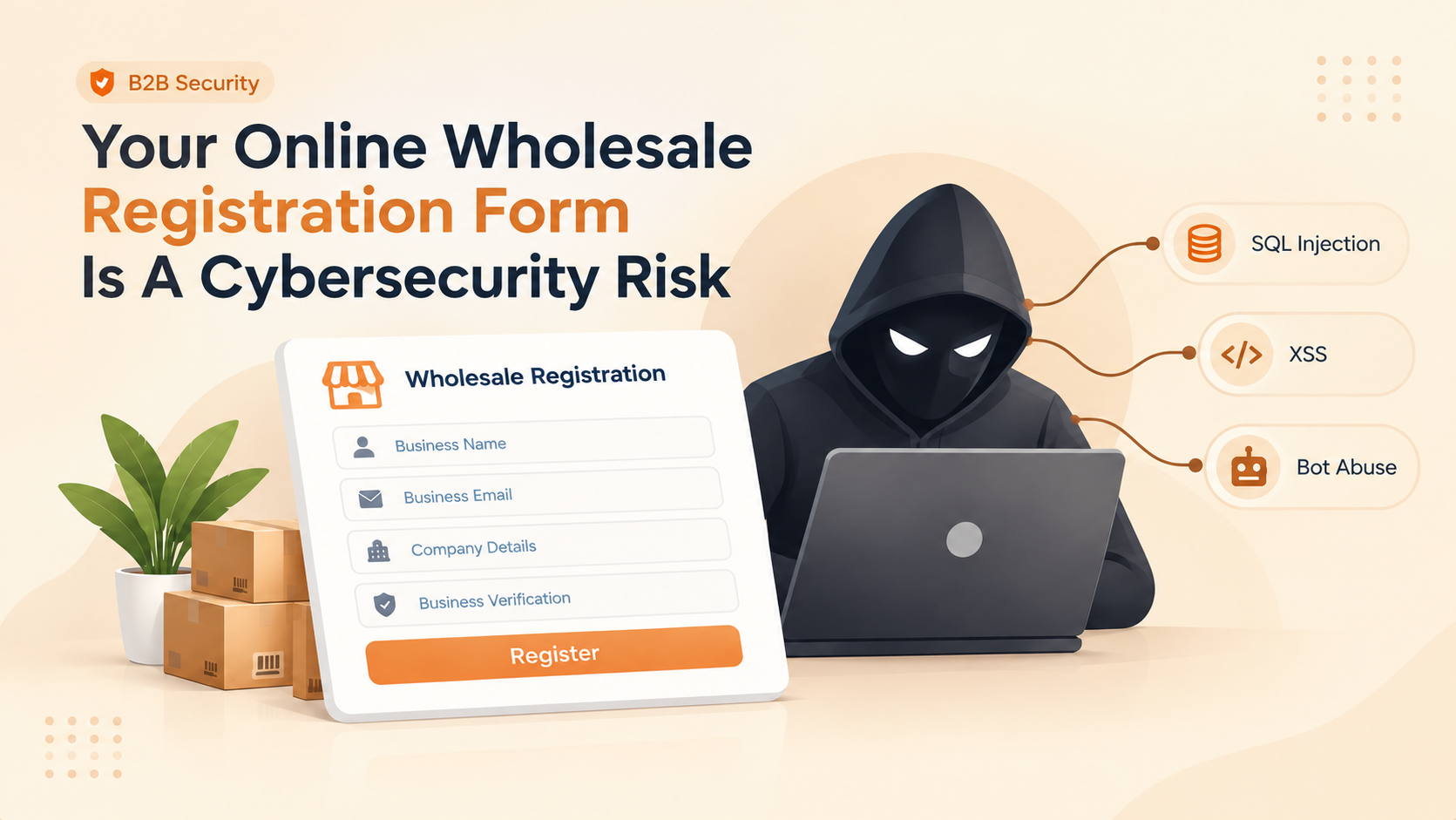
Onboarding new customers seems like a straightforward administrative task for a business-to-business store. You create a signup page, request business verification information, and begin authorizing accounts.
However, serious technical flaws that could jeopardize your revenue and system integrity can be concealed behind this seemingly standard entry point.
The Hidden Vulnerabilities in B2B Customer Onboarding
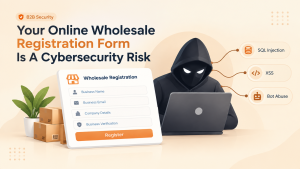
Wholesale portals could include credit terms, volume pricing, and access to commercially sensitive data. This creates security needs that are different from a typical public shop. Weak registration, authentication, and permission controls can let attackers use automated tools to create fake accounts, probe apps for weaknesses, or access protected information without authorization. Bots can also scrape pricing and catalog data from reachable endpoints.
A public registration form is an internet-facing application endpoint, not inherently an “open entry point” to the entire server environment. Nevertheless, insecure handling of user-controlled data can create exploitable vulnerabilities. SQL injection can occur when applications build unsafe database queries from user input, while cross-site scripting (XSS) can arise when untrusted content is rendered without appropriate output encoding or sanitization. Input validation is important, but it is not the primary defense against either vulnerability: parameterized queries are the preferred defense against SQL injection, while context-aware output encoding and, where necessary, HTML sanitization are central defenses against XSS.
The impact also depends on the vulnerability. SQL injection can expose, alter, or destroy database data when successfully exploited and permissions allow it. XSS primarily executes malicious content in a user’s browser and can lead to session theft, impersonation, or data exposure; it does not automatically mean that the underlying database has been compromised.
Automated scanners and bots can probe websites and APIs for weaknesses at scale. Current commerce-security research also documents substantial bot activity involving scraping, account abuse, application attacks, and API attacks. However, the claim that B2B commerce platforms inherently contain “more valuable” data than consumer-facing sites is unverified and should not be treated as a general fact.
To preserve operational safety and safeguard organizational resources, these touchpoints must be secured.
How Misconfigured Forms Threaten Business Security
The consequences can extend far beyond a few fraudulent accounts when store owners handle wholesale applications without adequate threat mitigation. Infrastructure, user validation, and application security should all form part of your overall platform security strategy.
Essential Security Steps for B2B Registration
- Secure input handling: Use server-based syntactic and semantic validation of untrusted input, but do not rely on validation alone to prevent injection attacks. Use parameterized database queries for SQL operations. Use output encoding or sanitization suited to the context for presenting user-controlled material.
- Check custom code often: Check custom registration code, plugins, and dependencies based on how dangerous they are and when big changes are made. Keep parts up to date and try changes that could affect security before putting them into production. Code review lowers risk, but it can’t promise that third-party software is bug-free.
- Set up two-factor authentication: As much as possible, make privileged and managerial accounts require MFA. One of the best ways to protect against password-based attacks like credential stuffing is to use multifactor authentication (MFA). However, protecting administrator accounts only leaves user accounts without MFA open to attacks.
- Rate-limiting restrictions: Putting rate limits and signup-speed controls on endpoints that are likely to be abused, like registration, login, and others. Limiting the rate of requests can make it harder for botnets to make automated accounts, attack credentials, and flood servers with requests, but it shouldn’t be used as a defense against botnets on its own. It should be used as part of a bigger set of rules.
- Keep secured storage. Limit the sensitive business-verification data you hold, limit access according to least privilege, and encrypt sensitive stored information when the threat model calls for it. Encryption must be combined with good key management; access control remains critical when data is encrypted.
A thorough understanding of secure programming, application security, identity management, and network security can help teams build a more defensible digital ecosystem. Structured education is one way—not the only way—to develop these skills. Professionals comparing academic options can review the Research.com list of budget-friendly online cybersecurity degrees and independently verify each program’s accreditation, curriculum, and costs.
Protecting Wholesale Data and Pricing Structures
Many B2B platforms use private catalogs, negotiated pricing, customer-specific discounts, or tiered prices. If authorization is implemented incorrectly, users who have not been approved for particular resources could obtain access to information intended for verified partners.
Access to protected pricing and catalog data should be enforced through server-side authorization checks rather than merely hiding information in the interface. Role-based access control can be suitable for some applications, although more fine-grained attribute- or relationship-based authorization may be appropriate for complex systems. Permissions should be validated for each protected request, and access should be denied by default.
| B2B Onboarding Threat Vectors
[Registration Form] → Unsafe Input Handling → SQL Injection / XSS Risk [Catalog Access] → Weak Authorization → Unauthorized Price or Data Access [User Validation] → Automated Abuse → Fake Accounts / Credential Attacks |
Log and keep an eye on application and authorization events that are important for security. Events like failed attempts to log in, administrative work, and changes to privileges should be recorded by systems so that any strange behavior can be looked into. You can also improve detection by monitoring API request trends and unusual permission changes, but you don’t need to watch every variable or request all the time.
Data Science Insights into B2B User Behavior
There should be a balance between abuse risk and the work users have to do. A new report from the World Economic Forum says that digital trust frameworks stress safety, privacy, openness, responsibility, and smart data use.
Platforms can use data on how users interact with them to build adaptive verification systems. Risk-based systems might consider things like an IP address’s reputation, the speed or timing of requests, the characteristics of the device or browser, and unusual behavior patterns.
Then, applications that look sketchy can get more checks, while lower-risk applications can move forward with less friction. Device fingerprints and behavioral tracking can raise privacy concerns, so use them with care.
Strengthening Your Platform Defense Strategy
Achieving B2B access requires a defense-in-depth approach for your web application stack. CAPTCHA can assist slow or identify some automated abuse, but should not be relied on as the only line of security against current bots. Currently OWASP advocates layered anti-automation protections, as CAPTCHAs can be defeated by automated systems, or outsourced to humans solving services.
E-commerce platform basic protections
- Use web application firewalls where applicable: A WAF can detect or prevent some malicious HTTP traffic and can provide a helpful defense-in-depth layer. It is not a replacement for secure coding, proper authorization, parameterized queries or XSS countermeasures.
- Update plugins and dependencies: Make that e-commerce software, plugins, themes, libraries and custom code are patched and supported. Remove abandoned or superfluous components. Use e-commerce security testing to find known vulnerabilities before they are exploited.
- Encrypt sensitive data at rest properly: Base encryption choice on the threat model of the system and regulatory needs, not that AES-256 must be used for every database field. OWASP recommends employing AES with a secure mode and a key of at least 128 bits (preferably 256 bits) where symmetric encryption is appropriate. Key storage and rotation are just as vital.
- Audit server configuration: Review server and cloud settings for exposure, insecure defaults, directory listing, excessive rights and incorrectly protected resources. Sensitive directories should be secured with genuine access restrictions, not by hiding them from web crawlers, which is no security border at all.
- Perform vulnerability assessments: Security-sensitive registration and user management features should undergo appropriate code review, security testing, and vulnerability assessments before or as part of production deployment, with testing repeated after material changes.
Hardened server configurations and appropriate backend maintenance are also essential components of a secure architecture. HTTP security headers provide additional protection when correctly configured. HSTS helps browsers enforce HTTPS and reduce exposure to downgrade or man-in-the-middle attacks, while Content Security Policy can reduce the exploitability of some XSS vulnerabilities. CSP is a defense-in-depth measure, not a substitute for correct output encoding and sanitization.
Safeguarding Store Infrastructure and Customer Data
Regular site health audits and security reviews help maintain a secure B2B environment. Adding third-party connectors may expand the attack surface as your store grows if those tools don’t receive adequate software maintenance.
For stores using WooCommerce, the official WooCommerce security guidance recommends keeping WordPress, WooCommerce, plugins, and themes up to date, installing software from reputable sources, reviewing custom code, and removing components that are no longer maintained or have known vulnerabilities.
Updating plugins and removing unnecessary software modules are important measures to reduce the attack surface and maintain security and compatibility.
Additionally, application and infrastructure performance contribute to availability, but optimized queries and caching cannot by themselves prevent a denial-of-service attack. Caching can improve resilience in some circumstances, while rate limiting, resource limits, scalable infrastructure, CDNs or DDoS-mitigation services, and graceful degradation may also be needed depending on the threat model.
The Broader Impact on Commercial E-commerce
Long-term operational growth can be affected by security decisions taken during the onboarding process. A single data breach can damage customer or partner trust, disrupt operations, and, when applicable laws have been violated, expose an organization to regulatory penalties. It is too strong to claim that the damage to market trust is necessarily permanent or that every breach results in a fine.
Wholesale retailers must adapt to increasingly complex attack methods as the broader e-commerce industry evolves. Treating security, privacy, and compliance as business priorities can reduce operational and regulatory risk and may support customer and partner confidence, but a “distinct competitive advantage” cannot be assumed.
|
Layered Defense Strategy WAF & Rate Limiting → Helps filter or constrain malicious automated traffic Risk-Based Verification → Adds checks for higher-risk applications Authorization Controls → Restrict protected wholesale pricing and catalog data Encrypted Storage & Access Control → Help protect sensitive documentation |
You also need strong protection for external communication channels connected to your registration form. Verification emails should use appropriate domain authentication. SPF and DKIM help receiving services authenticate legitimate mail, while DMARC lets domain owners specify how unauthenticated or misaligned messages should be handled and can help counter domain spoofing.
Using a reputable email provider can simplify authentication, reputation management, and delivery infrastructure, but no hosting provider can guarantee that messages will always reach the inbox or avoid spam filtering. Email authentication also does not mean that the underlying mail infrastructure can never be exposed or compromised.
Managing AI Risks and Emerging Vectors
Cyber threats and defense tactics have evolved due to the rapid adoption of AI tools. Current 2026 threat reporting documents sharp growth in AI-enabled automated traffic and attacks. AI-assisted tools can help attackers scale social engineering, phishing, identity fraud, and automated interactions with applications and APIs.
The ChatGPT log history shows recent advancements that demonstrate how quickly natural language models have evolved. Because legitimate AI agents and malicious automation can both generate realistic, well-formed interactions, security teams increasingly need to evaluate behavior, identity, authorization, and request context rather than assuming that every automated request is hostile.
|
AI Threat vs. Defense AI Threat Vectors: Automated Application Interaction / AI-Assisted Phishing / Synthetic Identity Data / Scaled API Abuse AI Defense Strategies: Layered Bot Detection / Behavioral and Network Signals / Risk-Based Verification / Strong Authorization |
B2B platforms can use behavioral and technical signals as part of a layered anti-automation strategy. Mouse movement, scrolling, typing cadence, request timing, browser or network fingerprints, and account velocity can contribute to bot-risk assessments, but they do not reliably prove that a visitor is human when used alone. Advanced automation can imitate some human behavior, and extensive behavioral tracking can raise privacy concerns. These signals should therefore support—not replace—authentication, authorization, rate limiting, verification, and other security controls.